
Public Transport in Dublin
Bus, Luas, DART and commuter rail in Dublin, routes, operating hours, Leap Card fares, fare caps and airport transfers at a glance.
Contents
Three pillars, bus, Luas and DART
Dublin's public transport runs under the umbrella of Transport for Ireland (TFI) and rests on three systems that complement each other well: the citywide bus network, the Luas tram, and the DART together with its commuter rail lines. For almost any route around the city there's a sensible combination, and thanks to the unified Leap fare system, transferring between them doesn't cost you extra.
The bus is the backbone of the network. Dublin Bus and Go-Ahead Ireland share the routes across the greater city; Go-Ahead operates around 64 of them, mainly outer and orbital routes plus many of the new BusConnects lines such as S4, S6, S8 or W2. For passengers this makes no difference to the price, both use the same TFI Leap system, only the routes and timetables differ. Most lines run roughly from 5.00 to midnight, with core routes every 5 to 15 minutes at peak times. As of February 2026 there are fifteen 24-hour routes, including 15, 39a, 41, C1 to C6, N4, G1, G2, E1, E2, F1, F2 and 80.
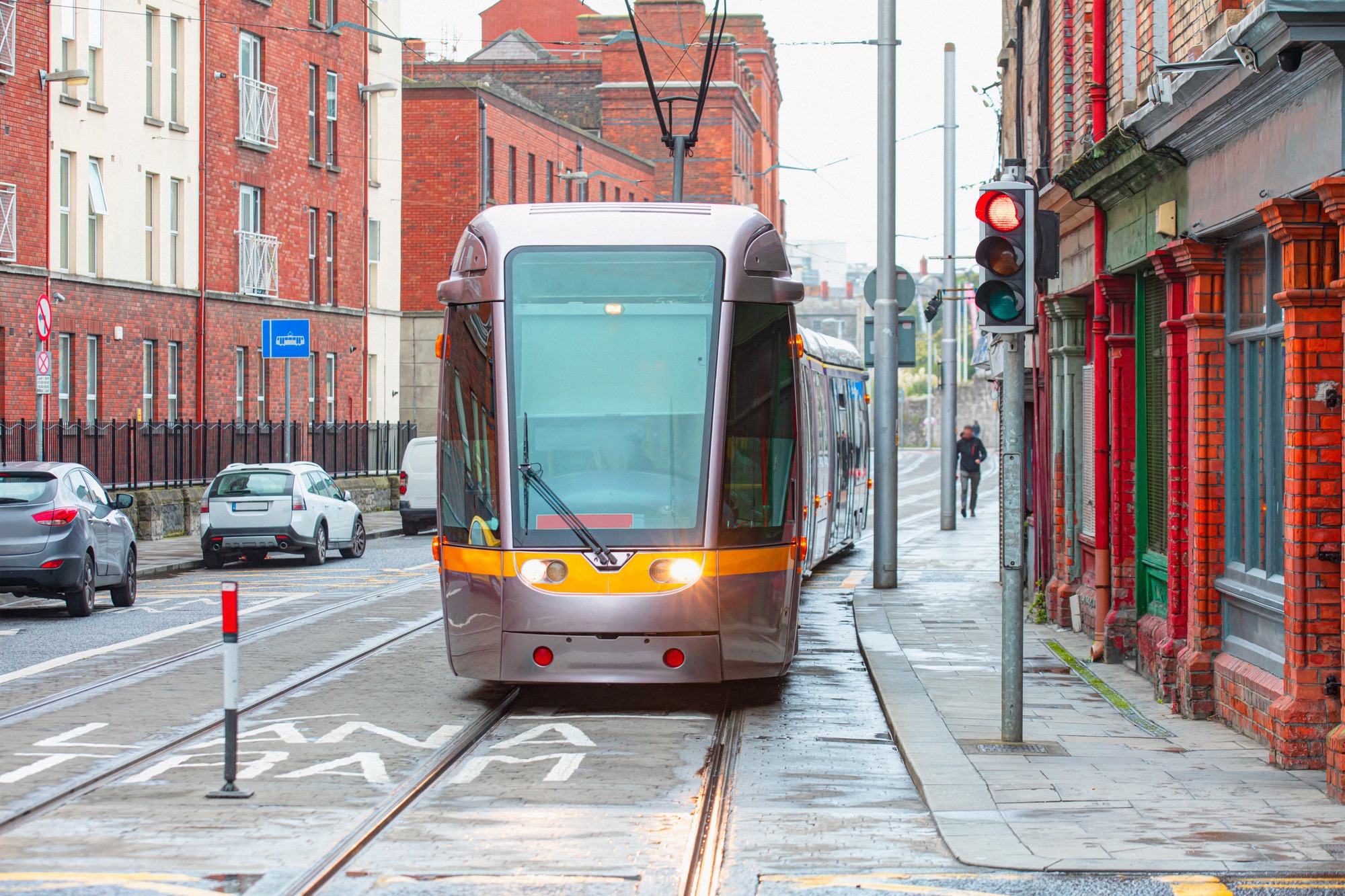
The Luas ("speed" in Irish) is Dublin's tram network with two lines: the Red Line running east-west and the Green Line running north-south through the centre. It operates roughly from 5.30 to 00.30 on weekdays, from around 6.30 on Saturdays, and from about 7.00 to 23.30 on Sundays. At peak times a tram comes every 4 to 6 minutes, otherwise around every 10 minutes; exact first and last services depend on the stop.
The DART (Dublin Area Rapid Transit) is the electric coastal line running along Dublin Bay. It connects Malahide and Howth in the north with Bray and Greystones in the south, and doubles as an affordable scenic ride along the sea. It's complemented by the commuter lines, which reach further out into the surrounding counties.
DART and commuter rail in detail
On the core stretch between Malahide and Bray, the DART runs roughly from 6.50 to 20.00 on weekdays at about every 10 minutes, and every 15 to 20 minutes outside those hours on weekdays. On Saturdays the service runs around every 15 minutes, and on Sundays around every 30 minutes. The outer branches to Howth and Greystones run less often, averaging a train every 30 minutes. The often-quoted 5-minute frequency is only a future target of the DART+ expansion programme and doesn't apply yet today.
If you want to travel beyond Dublin, the commuter lines are the way to go. The Maynooth line starts at Dublin Connolly and calls at, among others, Drumcondra, Broombridge, Ashtown, Navan Road Parkway, Castleknock, Coolmine, Clonsilla, Leixlip Confey and Leixlip Louisa Bridge before reaching Maynooth. The fastest Connolly-Maynooth connection takes around 30 minutes, though depending on the service it can take up to about 41 minutes.
Two destinations are particularly popular for day trips: the coastal town of Malahide with its castle sits directly on the DART network, and the journey from Malahide to Dublin Connolly takes around 28 minutes. Maynooth, with its university campus, is reached via the commuter line mentioned above. There's no consistently documented fixed frequency for the Maynooth line across the whole day, but trains run noticeably more often during peak hours than late in the evening.
Fares, how the Leap price works
The TFI fare system looks complex, but it comes down to one rule of thumb: cash is expensive, the Leap Card is cheap. Leap fares run up to 30 percent below cash tickets. Cash tickets on the bus aren't just pricier, the driver also won't take notes or give change (exact fare only), so route 41 to the airport costs €2.60 in cash instead of €2.00 with a card.
The centrepiece is the 90-minute fare. With a Leap Card, a journey within Zone 1, including all transfers between bus, Luas, DART and commuter rail within 90 minutes, costs a flat:
- Adults - €2.00 per journey
- Young adults (19-25) and students - €1.00 per journey
- Children and under-18s - €0.65 per journey
If your route extends beyond Zone 1, the commuter fares apply. On the bus, travelling from Zone 2 into the centre costs €3.70 (concession €1.85), from Zone 3 €5.30 (€2.65), and from Zone 4 €6.30 (€3.15). By train (DART/commuter), it's €3.90 from Zone 2 (€1.95), €6.00 from Zone 3 (€3.00), and €7.50 from Zone 4 (€3.75). The zone system is drawn generously: Zone 1 (TFI Dublin) reaches up to 50 kilometres from the centre, while Zones 2 to 4 cover the wider surrounding area, including Blessington, Drogheda, Navan or Kildare Town.
Fare caps, when you start travelling free
The biggest advantage of the regular Leap Card is fare capping: once you've paid enough in a day, you travel free for the rest of it. In Zone 1, the daily cap, applying across all modes of transport, is:
- €6.00 per day for adults
- €3.00 per day for young adults/students
- €1.95 per day for children
Across the week (Monday to Sunday), a weekly cap of €24.00 (adults), €12.00 (young adults/students) and €7.80 (children) also applies. Once you hit the limit, you travel free for the rest of the week. These caps have applied since 28 April 2025 and remain current, no price changes have been announced on the official sites for 2026. Worth knowing: the older single-mode caps that applied only to the bus or only to the Luas have been scrapped, capping now counts all journeys together.
For visitors who'd rather not do the maths, there's an alternative: the Leap Visitor Card, with unlimited travel for €8.00 for one day (24 hours), €18.00 for three days (72 hours), and €24.00 for seven days (168 hours). The validity period only starts with your first tap. It covers Dublin Bus, Go-Ahead, Luas, DART and commuter rail within Zone 1, including the return trip to and from the airport, but doesn't cover hop-on hop-off tours, Bus Éireann, or the express services Aircoach and Dublin Express. We cover which option pays off for your stay in detail in our Leap Card guide.
Where to get and top up a Leap Card
You can get a regular Leap Card or the Visitor Card from several places. TFI ships it online within 3 to 14 working days, which can be too slow for a spontaneous trip. Buying one on arrival is more practical: at the airport from WHSmith in Terminal 1 and Spar in Terminal 2, and in the city centre from, among others, the Dublin Bus office at 59 Upper O'Connell Street, various Spar branches, Easons, and the GPO. The card activates automatically the first time you tap it on a validator or turnstile.
A regular Leap Card can be topped up at Irish Rail and Luas ticket machines, at Leap agents, and at post offices. The most convenient option is the Leap Top-Up app straight from your phone, it works with NFC-enabled Android devices and the iPhone 7 or newer. That way you can add credit without hunting for a machine.
Getting to the airport and travelling at night
There's no direct train or tram link to Dublin Airport, the bus is your only option. The cheapest choice is the regular city routes: route 41 (Swords Manor - Lower Abbey Street) stops at, among other places, O'Connell Street and takes around 45 minutes into the centre, for €2.00 with a Leap Card instead of €2.60 in cash. Route 16 serves both terminals and stops centrally at, among others, O'Connell Street and College Green. Faster but pricier are the private express services running through the Dublin Tunnel: Dublin Express calls at more than 15 stops (Temple Bar, Trinity College, O'Connell Street, Heuston) for around €8 and runs daily from roughly 4.00 to 00.30; Aircoach (main route 700) runs about every 30 minutes for around €7, making it marginally cheaper than Dublin Express. You'll find every option in detail on our Dublin Airport page.
After midnight, Dublin Bus's Nitelink service takes over, running on twelve routes from the city centre (around D'Olier/Westmoreland Street) on Friday and Saturday nights, roughly from midnight to 4.00 every 30 to 60 minutes. It serves, among others, Dundrum, Tallaght, Lucan, Blanchardstown, Swords, Howth and Dún Laoghaire. Nitelink costs €2.40 with a Leap Card for adults, €1.20 for students/young adults, and from €1.00 for children. Whether night buses also run on Sundays isn't consistently documented, the official sources only mention Friday and Saturday nights.
Getting around with accessibility needs
The Luas and buses are largely accessible: the tram is step-free throughout, and the bus fleet is made up of low-floor vehicles with a fold-out ramp and wheelchair space. The train network needs a little more planning. The DART, Maynooth and Northern commuter lines work on a zonal accessibility policy made up of 13 zones with one to four stations each; you arrange assistance through the relevant hub station or the Customer Care Centre. For wheelchairs and mobility scooters, the limits are a maximum width of 700mm, length of 1200mm, and weight of 300kg.
If you need help boarding or transferring on the train, it pays to get in touch ahead of time: Irish Rail recommends four hours' notice for DART and commuter services so staff can have a ramp ready, and generally advises contacting them 24 hours in advance. One small but important quirk applies to everyone at the bus stop: you need to give the driver a clear hand signal, or they may not stop.