
Irish Traditions
Trad sessions, St Patrick's Festival, Guinness Storehouse, Irish food and literary heritage, where Dublin's living tradition really happens, with prices.
Contents
Where trad music really lives
Irish traditional music (trad) is one of Ireland's best-known cultural exports, but there's a world of difference between a genuine session and a show staged for tourists. At a session, musicians sit loosely in a circle and play reels, jigs and ballads on fiddle, tin whistle, bodhrán, flute and accordion, no stage, no set programme, often entirely spontaneous.
The most honest address in the city is The Cobblestone in Smithfield (77 King Street North), off the tourist trail and host to spontaneous sessions all year round. There are sessions here seven days a week - Monday from 18:30, Tuesday to Thursday from 16:30, Friday from 14:00 and at weekends from 14:30, each running until closing time. Entry is free, and local musicians are explicitly welcome.
Other reliable addresses:
- O'Donoghue's on Merrion Row, one of the city's most famous music pubs, closely tied to the rise of the Dubliners. Sessions on weekdays from around 21:00, Saturdays from around 17:00, free entry.
- Devitts on Camden Street, late-night sessions with younger musicians, less formal and good for newcomers, free entry.
- The Brazen Head (20 Lower Bridge Street), said to be Ireland's oldest pub (dating to 1198), with nightly sessions from around 21:00.
- Darkey Kelly's, live sessions on several days (including Wed/Thu from 19:30, Fri from 19:00, Sat from 18:30, Sun from 15:00), plus a Saturday ceili with dancing.
In Temple Bar, venues such as The Old Storehouse and Gogarty's run daily sessions from the afternoon, but they lean more towards tourists. Authenticity here has less to do with the season than with the choice of venue, a local pub like the Cobblestone almost always beats the Temple Bar stage. English is the language you'll hear spoken; Irish comes through in the lyrics, and you can join in without speaking a word of it.
What a session costs
Trad sessions in Dublin pubs are almost always free to enter, the only expectation is that you buy a drink. Only at special events is there occasionally a modest cover charge.
When it comes to beer, Dublin sits above the Irish average: at the end of March 2026, the national average for a pint of stout was around €6 (with €5.50 the most common price), while in Dublin €5.50 to €8.10 is typical. Temple Bar is noticeably pricier, and on St Patrick's Day some prices creep past €10. For a session evening with two or three pints, budget roughly €12 to €24 per person, or up to around €30 in Temple Bar. For more on drinking culture and how to pour the perfect pint, see our guide to Guinness & Whiskey, and for the nightlife areas and last-orders times see Nightlife in Dublin.
The St Patrick's Festival and the parade
17 March is Ireland's national day in honour of St Patrick, and Dublin celebrates it not for one day but as a multi-day festival. The St Patrick's Festival 2026 runs from Saturday 14 to Tuesday 17 March, under the theme "Roots".
The highlight is the St Patrick's Day Parade on 17 March, which sets off at 12:00. The route runs from Parnell Square along O'Connell Street and O'Connell Bridge into the southside, finishing at the junction of Cuffe Street and Kevin Street. More than 3,000 participants and twelve large floats move through the city with music and dance.
In practical terms: no tickets are needed for the parade, just pick a spot along the route. A limited number of paid grandstand seats are available. Because of the large crowds, arrive early and stake out your spot in good time. Other events throughout the year are listed in our events guide.
The Guinness Storehouse
The black beer with the creamy head has long been a symbol of Irish culture, and the Guinness Storehouse at St James's Gate (Dublin 8, D08 VF8H) is the city's most popular place to explore its story. Across several floors you learn how the beer is brewed; at the top, the Gravity Bar offers a panoramic view over Dublin.
The essentials:
- Opening hours: daily, usually 09:30 to 17:00 (last admission 17:00), extended to 19:00 in July and August.
- Prices: the basic experience starts from €22 with dynamic pricing; optional upgrades include the personalised Stoutie (+€8) and the Guinness Academy (+€12).
- Duration: typically around 1.5 to 2 hours.
Because of dynamic pricing and high demand, booking online in advance is worthwhile, it helps you avoid sold-out time slots and queues. If you want to go deeper into whiskey tradition too, continue with our guide to Guinness & Whiskey.
Traditional Irish cuisine
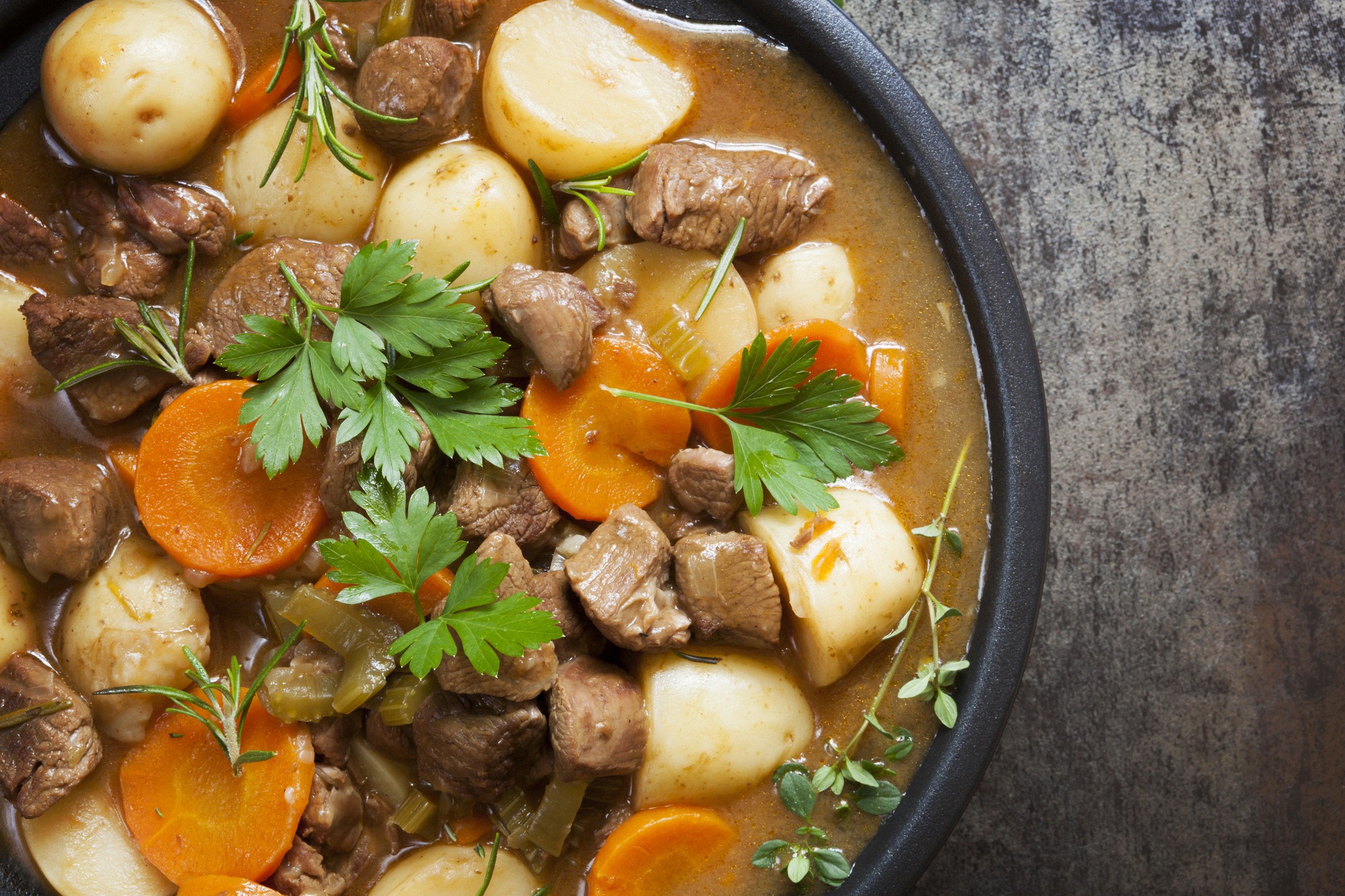
Irish cuisine is hearty and down-to-earth, and a few classics are best tried where they're still treated as everyday home cooking. The national dish is Irish stew, made with lamb and potatoes; closely associated with Dublin is also coddle, a dish of bacon, sausages and potatoes simmered together. Freshly baked soda bread almost always comes with it.
Reliable addresses for traditional dishes:
- The Brazen Head (20 Lower Bridge Street) serves Irish stew with fresh soda bread; mains run roughly €15 to €30.
- O'Neill's Pub & Kitchen near Trinity College (dating to 1713) is known for traditional home cooking, including lamb stew with homemade soda bread.
- The Old Mill Restaurant in Temple Bar serves Irish stew, Dublin coddle, Wicklow lamb shank and beef-and-Guinness stew.
- Madigan's on O'Connell Street offers lamb stew and soda bread.
The prices given are approximate ranges from travel-guide sources rather than up-to-date menu prices, the venue's own menu is what counts on the day. A fuller overview of dishes, markets and restaurants can be found in our Food & Drink guide.
Dublin as a city of literature
Few cities wear their literary heritage as openly as Dublin. In 2010, the city was named a UNESCO City of Literature, at the time only the fourth city in the world to hold the title, after Edinburgh, Melbourne and Iowa City. There are now more than 50 UNESCO Cities of Literature worldwide; the once-popular claim of being "one of four" only still holds as a historical note on that fourth naming.
Four Nobel laureates in literature were born in Dublin or are closely tied to the city: William Butler Yeats, George Bernard Shaw, Samuel Beckett and Seamus Heaney. Add to that giants such as James Joyce, Oscar Wilde, Bram Stoker, Jonathan Swift and Brendan Behan. More on these writers and their haunts can be found in our guide to literary Dublin.
One important note for planning: the former Dublin Writers Museum on Parnell Square has been closed since the pandemic and was permanently shut down in 2022, it will not reopen. The current point of reference is MoLI - Museum of Literature Ireland (86 St Stephen's Green, D02 XY43), open Tuesday to Sunday from 10:30 to 17:30 (last admission 16:30), closed on 17 March and over Christmas and New Year. Admission costs €14.50 for adults, €12 concession (children, students, over-65s) and €32 for families; from October to March, a public guided tour is included.
If you'd rather combine literature with pub culture, the Dublin Literary Pub Crawl is the one to pick: it starts at The Duke (9 Duke Street, D02 NR76), daily in summer and Thursday to Sunday in winter, each at 19:30, and runs for around two hours twenty minutes over just under a kilometre, costing roughly €20 to €22. Actors perform works by Joyce, Wilde, Behan and Beckett along the way, guiding you through four historic pubs and Trinity College. More guided walks are listed in our tours guide.
Temple Bar, more than a strip of pubs
Temple Bar is Dublin's official cultural quarter, and it's more than the evening pub strip it's often taken for. Tucked between the narrow lanes, active cultural venues operate through the day, so the neighbourhood's cultural reputation isn't outdated, it's current.
Worth seeking out:
- Temple Bar Gallery + Studios (5-9 Temple Bar, D02 AC84), with exhibitions and studio space.
- Photo Museum Ireland / Gallery of Photography on Meeting House Square.
- Irish Film Institute (IFI) (6 Eustace Street, D02 PD85), with arthouse cinemas and the national Irish Film Archive.
- Gaiety School of Acting (National Theatre School of Ireland) on Essex Street West.
- Project Arts Centre (39 East Essex Street).
Visit the quarter during the day and you'll find a quieter, more cultural side than the one you see at night. More galleries and museums in the city are listed in our Museums in Dublin guide.