
Literary Dublin - In the Footsteps of the Writers
Joyce, Wilde, Swift, Beckett - Dublin's literary heritage brought to life. Museums, landmarks and tours, with current prices and opening hours.
Contents
Few cities of its size have produced as much world literature as Dublin. Four Irish Nobel laureates in literature, plus Jonathan Swift, Oscar Wilde and James Joyce, the list reads like a canon of English-language modernism. The good news for visitors: much of it can still be walked today. Museums, houses, pubs and graves sit close together, often only a few minutes' walk apart. This guide points you to the key places and tells you what they cost and when they're open.
Dublin's literary museums
The flagship venue is the MoLI - Museum of Literature Ireland, on the south-west corner of St Stephen's Green. It occupies Newman House, the former seat of the Catholic University College Dublin, where James Joyce studied around the turn of the century and graduated in 1902. Among the highlights of the collection is "Copy No. 1" of Ulysses, the very first printed copy of Joyce's masterwork.
Practical to know: MoLI is open daily from 10:00 to 17:00, with last admission at 16:00; it is closed on 17 March, from 24 to 26 December, and on 1 January. General admission starts from €12, and a guided MoLI or Historic House tour costs €18 each. If your schedule is flexible, come on the first Friday of the month, when admission is free during the evening opening from 18:00 to 21:00. The address is 86 St Stephen's Green, Dublin 2; it's a short walk from the St Stephen's Green Luas stop.
The other must-see is the James Joyce Centre, housed in a restored Georgian townhouse at 35 North Great George's Street, north of the Liffey. Its most famous exhibit is the original front door of No. 7 Eccles Street, Leopold Bloom's fictional address in Ulysses. It isn't a replica but the genuine door: the house itself was demolished in April 1967, the Mater Private Hospital now stands on the site, and the door came to the Centre on loan in 1995. The James Joyce Centre is open Tuesday to Saturday from 10:30 to 16:30. Admission costs €7 for adults and €5 concession for seniors and students; children under twelve go free.
Jonathan Swift and St Patrick's Cathedral
Jonathan Swift (1667-1745), author of "Gulliver's Travels", was Dean of St Patrick's Cathedral from 1713 to 1745. In 1729 he published "A Modest Proposal", one of the most savage satires in literary history, an apparently sober suggestion to sell the children of poor Irish families as food for the rich, a biting indictment of the social distress of his time.
Swift is buried inside the cathedral, and his grave can be visited with a standard admission ticket, there is no separate access required. The cathedral is open Monday to Friday from 9:30 to 17:00, Saturday from 9:00 to 18:00, and Sunday from 9:00 to 13:00 and 16:30 to 18:00. Admission costs €11.50 for adults, €10 for students and seniors aged 60 and over, and €5.50 for children aged 6 to 12; under-fives go free, and a family ticket costs €31. If you also want to see the neighbouring Marsh's Library, a combined ticket at €17 works out cheaper.
Oscar Wilde and Merrion Square
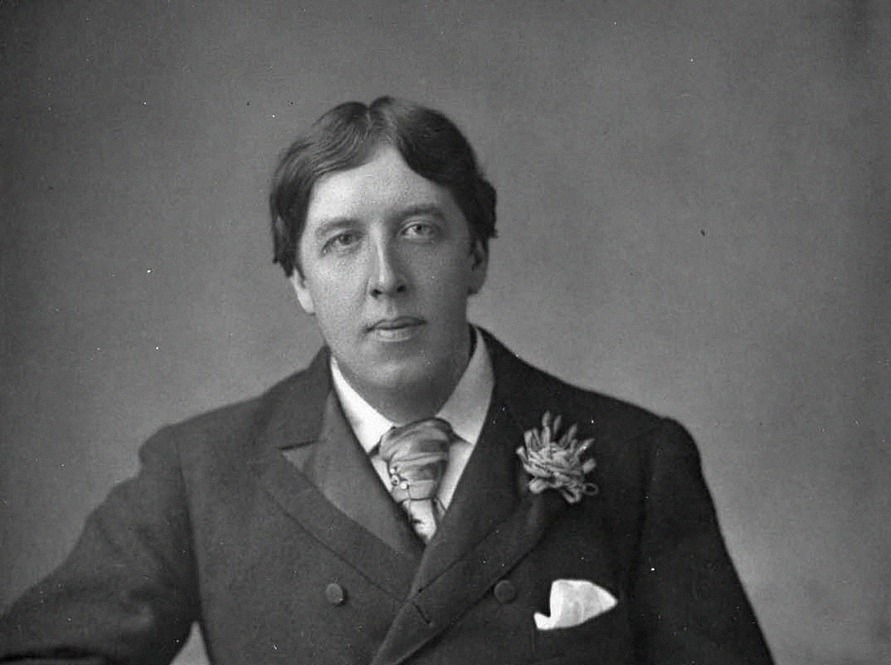
Oscar Wilde (1854-1900) grew up at No. 1, on the Georgian Merrion Square. The park's north-west corner now holds the colourful Wilde sculpture by Danny Osborne, unveiled in 1997 by Wilde's grandson Merlin Holland and commissioned by the Guinness Ireland Group. The figure is a small curiosity built from stone quarried on three continents: Wilde reclines on a boulder of Wicklow quartz, his torso is carved from green nephrite jade and pink thulite, his legs from Norwegian Blue Pearl granite, and his shoes from Indian charnockite. The two flanking bronze figures, a pregnant Constance Lloyd and a Dionysus, were returned to their plinths in 2016 after restoration.
Visiting costs nothing: Merrion Square Park is public and open to all. It opens year-round at 10:00, with closing times shifting by season - 17:00 in December and January, as late as 22:00 at the height of summer. The statue can be viewed free throughout the park's opening hours, with a view across to Wilde's childhood home.
Joyce, Bloomsday and the settings of Ulysses
James Joyce (1882-1941) spent most of his life in exile in Trieste, Zurich and Paris, and yet wrote almost exclusively about Dublin. "Dubliners", "A Portrait of the Artist as a Young Man", "Ulysses" and "Finnegans Wake" turn the city into a literary stage whose real-world locations can still be traced today.
The most popular occasion for doing so is Bloomsday on 16 June, the single day on which the whole of Ulysses takes place. The one day has long since grown into a multi-day festival: in 2026 it runs from 11 to 16 June with over 100 events across the city, readings, performances, walking tours, concerts, talks and plenty of visitors in Edwardian costume re-enacting the classic Bloomsday breakfast. Key locations include the Martello Tower in Sandycove (now the James Joyce Tower & Museum), Davy Byrne's pub on Duke Street, and the James Joyce Centre. For more on the tower itself, see our page on the James Joyce Tower. One small footnote along the way: the rescued original door of No. 7 Eccles Street is genuinely attested in two places, the one at the James Joyce Centre is the real one, while publisher John Ryan once fitted another door from the same house into his pub, The Bailey, on Duke Street.
Four Nobel laureates, and their city
With a population of just a few million, Ireland has produced four Nobel laureates in literature: William Butler Yeats (1923), George Bernard Shaw (1925), Samuel Beckett (1969) and Seamus Heaney (1995). Three of them have a firm Dublin connection. Yeats lived for a time on Merrion Square and was among the founders of the Abbey Theatre. Shaw was born on Synge Street and remains the only person to have won both the Nobel Prize in Literature and an Oscar, in 1938, for the screenplay of "Pygmalion". Beckett grew up in the southern suburb of Foxrock before moving to Paris; he traditionally opens the literary pub crawl, with a scene from "Waiting for Godot".
Joyce himself, often called the greatest of them all, is among the notable non-winners, a favourite detail that shows just how crowded the literary field in this city really is. Anyone wanting to dig deeper into the classic, historic figures has plenty to work with; younger Dublin voices such as Maeve Binchy, Anne Enright, Colm Tóibín and Sally Rooney round out the picture into the present day.
Sean O'Casey, Flann O'Brien and the city's wit
Two Dublin writers embody the ironic, often political side of Irish literature. Sean O'Casey (born John Casey on Upper Dorset Street) became General Secretary of the Irish Citizen Army in March 1914, but resigned again as early as July that year, rejecting the alliance with the Irish Volunteers. He took no part in the 1916 Easter Rising. His plays, such as "Juno and the Paycock", portray strong female characters holding their own against poverty and political upheaval.
Flann O'Brien, alias Brian O'Nolan, alias Myles na gCopaleen (1911-1966), wrote in both English and Irish and is regarded as a master of absurdist humour. He is credited with the much-quoted joke that if you added up every Irishman who later claimed to have been at the General Post Office on Easter Monday 1916, the building would have needed to hold well over a million people. His novel "At Swim-Two-Birds" was published on 13 March 1939 and initially sold poorly, only around 240 copies, with the remaining stock destroyed in an air raid in 1940. It was only the 1960 reissue that brought its breakthrough. The book never became a classic bestseller, but it did become a cult favourite and a landmark of metafiction, and it now features regularly on lists of the best English-language novels.
On your own or with a guide, the Literary Pub Crawl
If you'd rather not explore literary Dublin alone, the Dublin Literary Pub Crawl is a good option. Two professional actors perform extracts from the works of Joyce, Behan, Wilde and Beckett along the way, leading the group through four pubs. It starts on the upper floor of The Duke, at 9 Duke Street.
- Start time: 19:15, daily from April to October, Thursday to Sunday from November to 31 March; year-round there's also a Sunday show at 12:00.
- Duration and scope: around 2 hours 20 minutes, four pubs.
- Price: from €23.
One venue is deliberately missing from this list: the Dublin Writers Museum on Parnell Square, for decades the first port of call for literary Dublin, has been permanently closed since March 2020; according to MoLI, its collection passed to them.
If you'd rather put together your own itinerary, combine MoLI, the James Joyce Centre and Merrion Square into a literary day and start or finish nearby in Temple Bar. For more guided walks and tours, see our guide to Tours and Day Trips.