
Car Hire
Car hire from Dublin: driving on the left, M50 toll, insurance, speed limits and airport pick-up, practical advice for your Ireland road trip.
Contents
Dublin itself is best explored on foot and by public transport, in the compact city centre a car is more of a burden than a help. But once you want to head out into the countryside, along the Wicklow coast, into the Burren, or across the border to Northern Ireland, a hire car comes into its own: you're independent of bus timetables and can reach places public transport only serves in a roundabout way. This guide covers what you should know before booking and behind the wheel, from the toll system to insurance to driving on the left.
Picking up at Dublin Airport
For most visitors, Dublin Airport (DUB) is the most practical starting point: the major rental firms have counters and pick-up points right at the terminal, so you can get on the road as soon as you land. Providers include Hertz, Enterprise, Europcar, Sixt, Avis, Budget, Dooley and Easirent, as of spring 2026, around 27 providers are listed across the booking portals, so choice is wide.
On price, it pays to book early, since rates swing sharply with the season. As a rough guide, small and compact cars usually sit in the low double-digit euro range per day, with SUVs considerably more. Winter is cheapest - February rates run noticeably below the yearly average, while the summer months are high season and markedly more expensive. Firm day-to-day prices per company can't be pinned down reliably, since portal rates are dynamic; comparing prices shortly before booking remains essential.
Two things worth settling at the time of booking:
- Transmission: in Ireland, most of the rental fleet is manual, roughly four cars out of five. Automatics are rarer and pricier; the surcharge usually isn't a fixed fee but shows up in a higher daily base rate (an automatic economy car can run €35-50 a day instead of the roughly €25-35 for a manual). Automatics sell out fast in summer, so book as early as you can.
- M50 toll: it's worth confirming directly with the rental company how the motorway toll around the city is billed (more on this below).
Minimum age, licence and requirements
The usual minimum age for car hire in Ireland is 21, though some firms require 25. Drivers under 25 pay a young-driver surcharge with most providers. There are sometimes upper limits too: some rental companies apply special conditions from around age 70 to 75.
You'll need a full, valid driving licence, held for at least one to two years depending on the company. Good news for visitors from the EU, UK, US, Canada or Australia: these licences are accepted directly, and an International Driving Permit (IDP) is not required. An IDP is only needed if the licence isn't issued in Latin script or in English.
The M50 toll, understanding the eFlow system
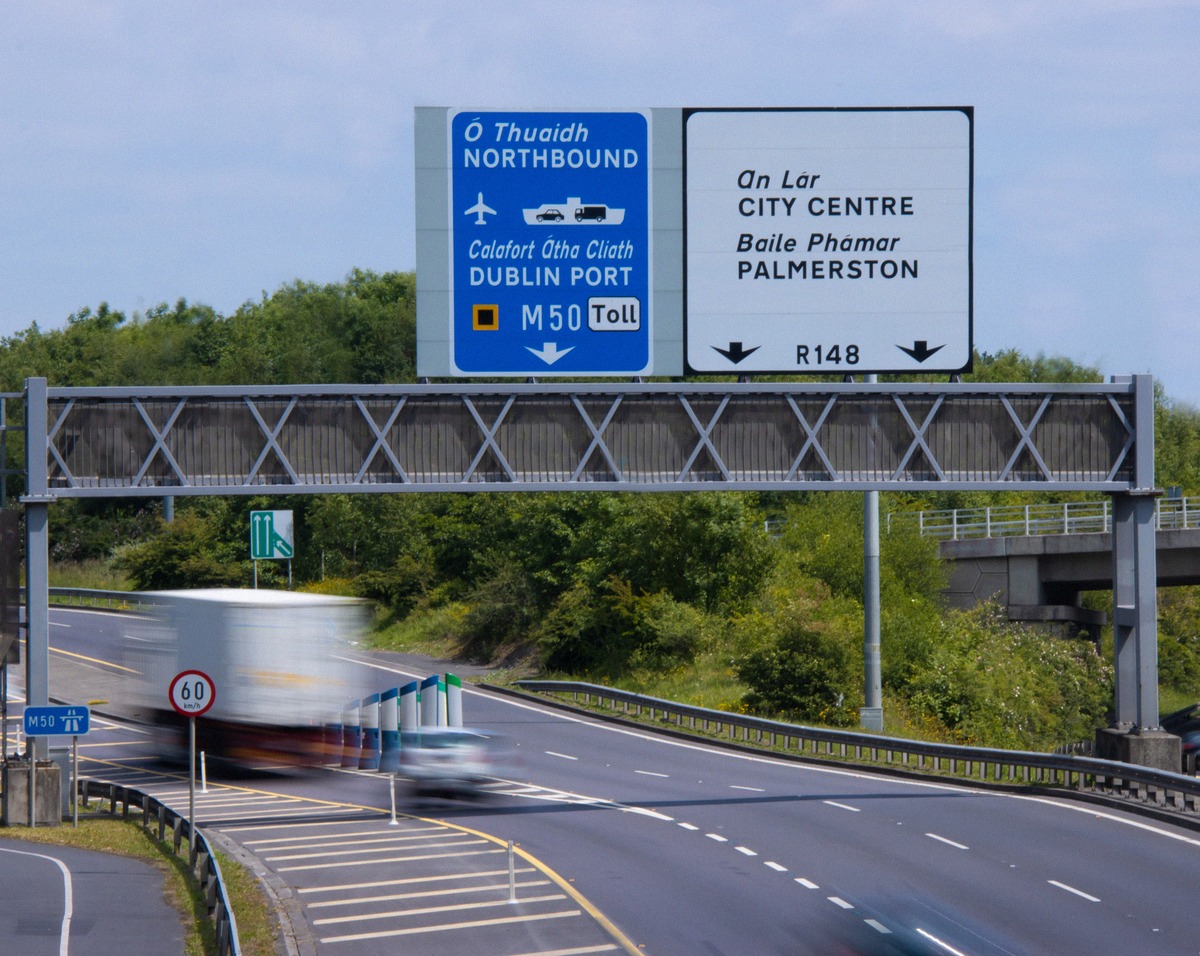
The toll that matters most for visitors to Ireland is the M50, the motorway ring around Dublin. Between Junction 6 (N3 Blanchardstown) and Junction 7 (N4 Lucan) it's collected barrier-free through the eFlow system: there's no toll booth and no cash payment, cameras read the number plate automatically. This is exactly where the trap lies: you drive straight through without stopping, and it's on you to sort out payment afterwards.
The toll is compulsory and must be settled by 20:00 on the day after you travel, whether online at eflow.ie, by phone on 0818 501050, or at a Payzone outlet. Miss the deadline and you risk a penalty charge. The 2026 car rates (typically raised by about 10 cents in January) apply regardless of time of day, there's no peak/off-peak tariff:
- €2.60 with an electronic tag
- €3.20 with a registered video/post-pay account
- €3.80 for unregistered drivers (one-off video toll)
With a hire car this usually runs automatically through the rental company: the major firms (Hertz, Enterprise, Europcar, Avis, Sixt, Dooley) have eFlow agreements and bill the toll plus an administration fee, typically €3 to €5 per crossing, sometimes more (Budget/NewWay, for example, charges €3.80 plus €1.23). If you'd rather avoid that, you can register the number plate yourself through the eFlow app and pay only the cheaper account rate. Check the arrangement before pick-up so there are no surprises later.
One piece of good news to close this section: as of 2026, Dublin has no low-emission zone (LEZ) and no city congestion charge. It was confirmed in January 2026 that a congestion charge won't be introduced for now. Local authorities do have to draft transport plans by the end of 2026 that could pave the way for such measures in future, but nothing of the kind is in force at present.
Insurance and excess
A collision damage waiver (CDW) is included in the rental price by law, but with a high excess, typically between €1,500 and €2,500 (economy and compact cars tend to run €1,500-1,800, SUVs around €2,000-2,500). In the event of damage, you're liable up to this amount yourself. A Super CDW, or full cover, reduces the excess to €0-250 and costs roughly €15 to €30 per day.
Worth knowing for Irish conditions: tyres, wheels and glass aren't covered under the standard CDW. On narrow roads lined with stone walls, hedges and tight lanes, these are exactly the most common types of damage. Separate tyre and glass protection (from around €7 per day) is therefore often worth adding. Breakdown cover is either included or available as an add-on depending on the tariff, if you do break down, it's handled through the hotline the rental company gives you.
At pick-up, don't skip the vehicle check: go over every scratch, dent, chip in the glass, the tyres, the interior and the lights inside and out, have any existing damage logged on the damage report or vehicle diagram, and take your own photos or video of all sides, the roof, the wheels and the windscreen as well. If you break down on the road, call the rental company and follow their instructions, don't arrange a repair yourself.
Rules of the road, driving on the left, speed limits, drink-driving
The most important point: Ireland drives on the left. The steering wheel, gear position and roundabouts are all mirror images of what you're used to. The first few kilometres take full concentration, especially at junctions, when turning, and at roundabouts (which you go round anticlockwise). Allow a bit of extra time for the start and take it easy at first.
The 2026 speed limits (in km/h):
- 50 in towns and villages, sometimes 30 in residential areas
- 60 on rural local roads (lowered from 80 in February 2025)
- 80 on regional roads
- 100 on national roads and dual carriageways
- 120 on motorways
Note that a reduction on National Secondary Roads from 100 to 80 km/h is planned for later in 2026, so the signage on the road is the definitive reference. The drink-driving limit is 0.05% (50 mg/100 ml of blood) for experienced drivers and 0.02% for learner and novice drivers. Even at 0.05-0.08%, penalties are stiff, a fine of up to €2,000 plus a three-month driving ban, so if you're driving, skip the pint at the village pub too.
Allow more time than the distance alone suggests once you're off the motorway: roads narrow and wind quickly, and you may well find a herd of sheep crossing your path.
Parking in Dublin
If you do bring the car into the city, on-street parking runs on the pay-and-display system, with rates staggered by colour zone per hour:
- Yellow: €4.00
- Red: €3.50
- Green: €2.00
- Orange: €1.20
- Blue: €0.90
You pay at a machine or via an app. There are also multi-storey car parks in the centre; their rates vary, so check on the day. On the whole, a car is rarely the best choice for sightseeing within Dublin itself - public transport is cheaper and less stressful, and a hire car pays off once you head out for day trips beyond the city.
Driving into Northern Ireland
A side trip into Northern Ireland, to the Giant's Causeway, say, is possible with a car hired in the Republic. Because Ireland and the UK are both part of the Common Travel Area, statutory third-party liability cover applies across the border automatically, and no GB/UK sticker is required.
You do need to tell the rental company about the border crossing, though, since comprehensive and theft cover sometimes only apply with their explicit consent. Many rental firms charge a flat cross-border fee; the amount varies widely and isn't consistently documented, so ask directly. Whether a Green Card is still issued as proof depends on the rental company, under EU rules it's formally no longer required for travel between Ireland and the UK since 2021, but practice varies. If you want to be on the safe side, get all of this confirmed in writing before pick-up.
Planning a bigger loop rather than just a city break? Our overview of Tours & Day Trips will help you choose destinations around Dublin.