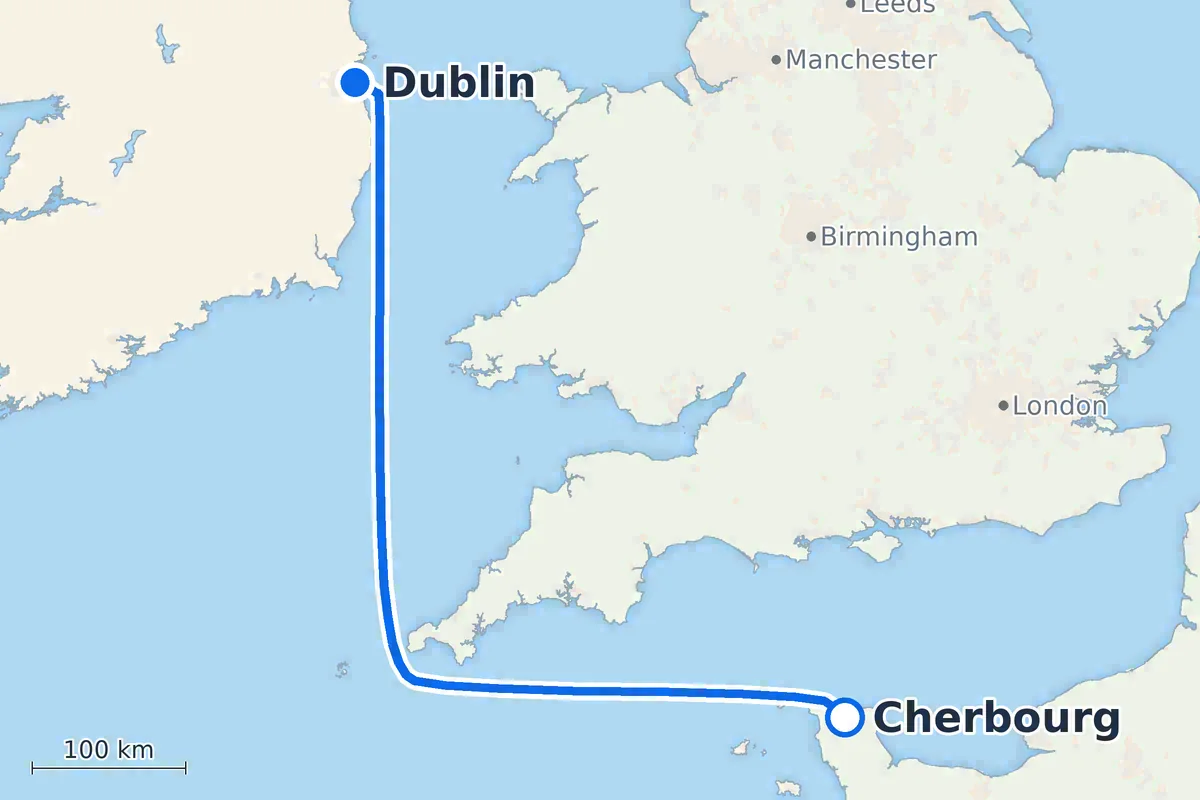
Cherbourg - Dublin
Overnight from Normandy straight to Dublin, 19 to 21 hours

From
€91
Three routes reach Dublin Port and two former diversions have gone. What runs from Britain, what changes at check-in this September and how to get into the city.
Crossings
The two routes into Dublin plus the southern Irish ports, with the operator and crossing time for each.
Prices per person, one way
© OpenStreetMap contributors
For a trip to Dublin with a car, a campervan or a dog, the ferry does something flying cannot: you drive on with your luggage and your vehicle, and you are mobile the moment you land. Travelling on foot, it is rarely the quickest or cheapest way. This guide sets out which routes actually run, what has changed on the Holyhead crossing, and what to expect at Dublin Port.
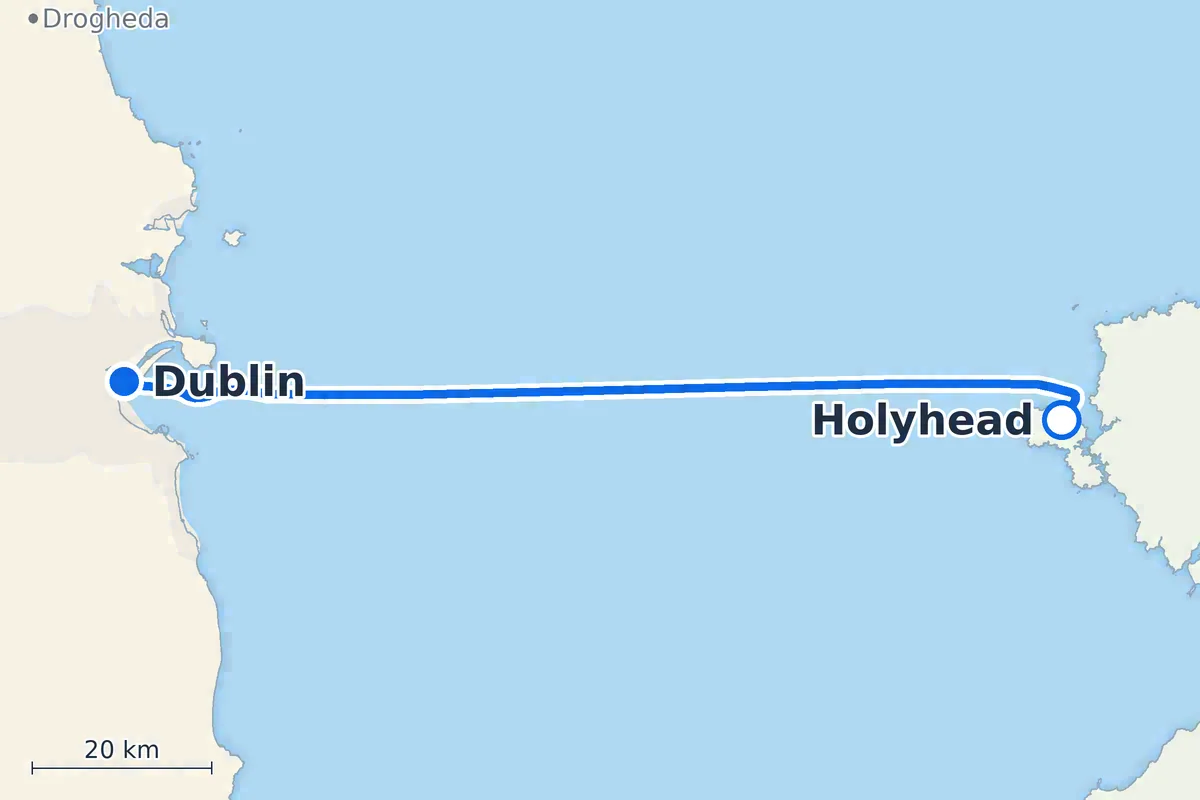
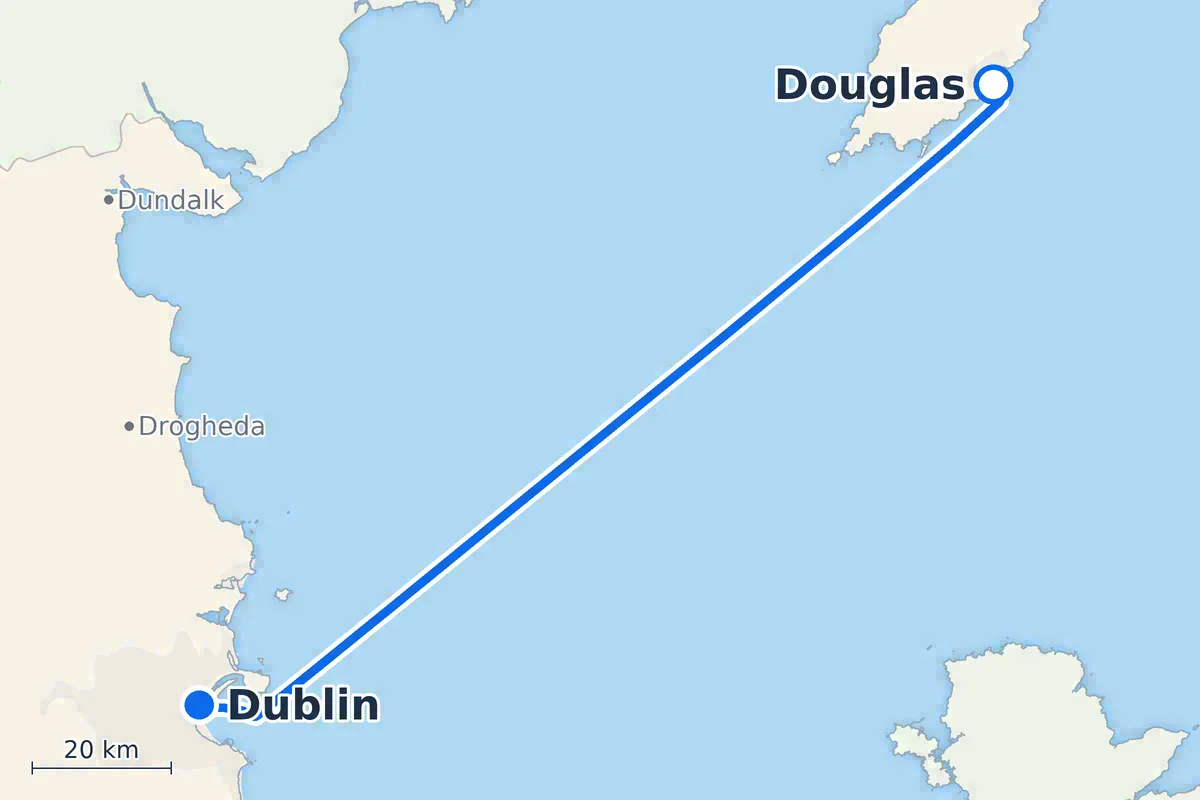
Fewer than most comparison sites suggest. Three routes reach the port:
Two crossings that still show up in search results have gone. Pembroke to Dublin and Fishguard to Dublin ran as diversions while Holyhead was working at reduced capacity, and they are out of service. From south-west Wales the ferries now go to Rosslare in the south-east corner of Ireland, roughly two and a half hours' drive from Dublin.
Liverpool to Dublin is not a passenger option either. P&O Ferries closed that route at the end of 2023, and Stena Line lists Dublin to Liverpool in its freight network only, for accompanied lorries. From the north of England, and from Scotland too, Holyhead remains the crossing for Dublin; the Cairnryan sailings go to Belfast and Larne, not to Dublin.
Map
Two operators run the crossing in parallel, and that is its real advantage: if a sailing is cancelled, the next one is usually two to three hours away rather than the next day.
One thing worth knowing before you book on the strength of a crossing time: the Dublin Swift. Irish Ferries still lists the fast ferry on its route page at just over two hours, but in the operator's own published sailing list every Dublin Swift departure in both directions is marked "No Sailing", with passengers moved onto the Ulysses or the James Joyce. Plan around the longer crossing, and check which ship is allocated when you book rather than relying on the two-hour figure.
On check-in, Irish Ferries gives 30 minutes before scheduled departure as the latest time on Dublin to Holyhead, for vehicles and foot passengers alike. Stena Line publishes the cut-off per sailing, listed separately for cars and foot passengers. Allow more in the summer: the deadline runs from the scheduled time even when the ship sails late.
This is the change to plan for. From Monday 28 September 2026 Stena Line requires every passenger boarding at Dublin, Holyhead, Fishguard or Rosslare to present a valid passport at check-in. It applies whatever your age or nationality, so babies need their own, and it applies to Irish citizens travelling inside the Common Travel Area. A driving licence, a birth certificate or any other photo ID will not be accepted; an Irish passport card will. The reason is UK Border Force requirements on the accuracy of passenger data before boarding.
Two practical points. If your child has a different surname from yours, no extra evidence is required, but carrying a birth or marriage certificate is sensible; if you do not have parental responsibility for a child you are travelling with, carry a letter of permission. And nothing changes on the routes from Belfast, Liverpool, Cairnryan or Heysham, so a Northern Ireland crossing still works on the old rules. What Ireland itself asks of arriving travellers is covered in our guide to entry requirements for Ireland.
Pick your date and route. Sailings back from Dublin are on the second tab.
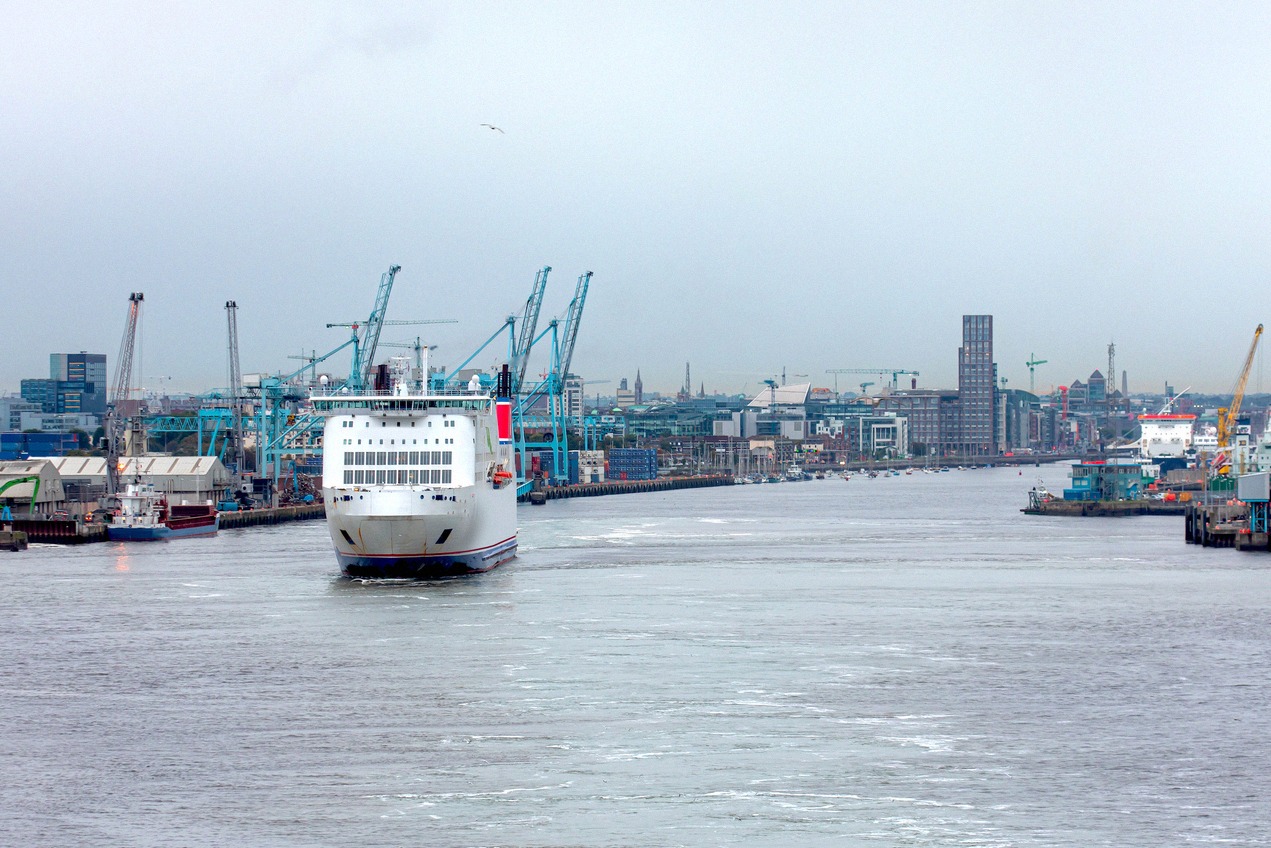
The port sits north-east of the centre at the mouth of the Liffey. The port company gives 2.7 km to the city centre, but the passenger terminals are further out than the entrance: Stena Line puts its own terminal at 6 km, four miles. Which terminal you land at decides how you get in:
There is no rail link, and the obvious-looking option is a trap. The Luas Red Line stop at The Point is opposite the port entrance on East Wall Road, but from Stena Line's terminal it is a 3.2 km walk of around 40 minutes. As a foot passenger, plan the transfer:
| Service | From | Journey | Single fare |
|---|---|---|---|
| Bus 53 (Dublin Bus) | Terminal 1 | to Talbot Street | standard Dublin Bus fare |
| Stena Line transfer coach | Terminal 2 | 30 to 35 minutes | £3 (£4.50 to Heuston Station) |
| FerryLink shuttle | Terminal 1 | to the city centre | €4.50 |
| Taxi | either terminal | 15 to 25 minutes | metered |
As of September 2026. Bus 53 runs from Terminal 1 via Connolly Station to Talbot Street and does not serve Terminal 2. Stena Line's coach runs for every sailing and calls at Connolly Station, George's Quay, Aston Quay and Heuston Station on the way in; it leaves Terminal 2 at 00:10, 05:50, 12:55 and 18:40, and Heuston Station at 00:40, 06:40, 13:35 and 19:20. Buy tickets online, at the travel centres in Holyhead and Dublin, or from guest services on board. The FerryLink shuttle is cashless, paid by card with the driver. For getting around once you are in, see our guides to public transport in Dublin and the Leap Card.
Most people on this crossing bring a car, so three local details are worth knowing before you roll off the ramp.
Alexandra Road has been closed to port traffic since July 2025 and stays closed until autumn 2026, with all access running via Promenade Road. Follow the port signage rather than your satnav. The Dublin Tunnel starts at the edge of the port estate and takes you straight onto the M50 and M1, which keeps you out of city traffic entirely. And the M50 is a barrier-free camera toll between junctions 6 and 7: nobody takes your money at a booth, so you have to pay it yourself by 20:00 the following day through eFlow or the M50 app, or a penalty follows the registered keeper. That catches out visiting drivers more than any other rule in Ireland.
Parking at the terminals is card only, paid through an app or a QR code, at €9 per 24 hours and €50 per week (as of September 2026). Both terminals have space, and Terminal 1 is the larger of the two.
Fares are dynamic. A "from" price is the cheapest rung of a ladder that climbs with demand, lead time and vehicle length, which is why no fixed figure belongs on this page. Four things decide what you pay: the date (July, August and bank holidays are dearest), how far ahead you book, the vehicle rather than the number of passengers, and extras such as a cabin or a pet space. The full comparison of how the fares work is on ferryireland.com.
The ferry earns its place in three cases:
Travelling alone or as a couple on foot, flying almost always wins: there are frequent flights to Dublin from airports across Britain and Ireland, and the drive to Holyhead counts as part of the ferry journey. The crossing is only one leg of it. Our guides to flights to Dublin, Dublin Airport and hiring a car in Ireland cover the alternatives.