
Swords Castle
Medieval seat of the archbishops of Dublin, free to visit
A fortified 13th-century residence of the archbishops of Dublin, now a free national monument and a peaceful hidden gem north of Dublin.
Contents
Swords Castle is the only substantially preserved fortified residence of the medieval archbishops of Dublin. The site lies around ten kilometres north of the city centre in the Fingal area and is protected as a national monument. Unlike nearby Malahide Castle, Swords is free to visit and usually very quiet, a rewarding stop for anyone who wants to explore medieval fabric without the crowds.
History and origins
The castle traces back to John Comyn, the first Anglo-Norman archbishop of Dublin. After taking office in 1181, Comyn chose Swords as his main residence, likely because of the wealth of the local benefice. Construction of the manor is thought to have begun around 1200. A monastic settlement, attributed to Saint Columba (Colmcille), had already existed on the site since the 6th century.
Swords Castle served primarily as a residential and administrative seat rather than a military fortress. The archbishop maintained his own constable here, along with an ecclesiastical court. In 1193, Comyn was granted the right to hold an eight-day fair each year on the feast of St Columban (9 June). These privileges made Swords the "Golden Prebend," supplying almost half of the archbishop's annual income.
Architecture and layout
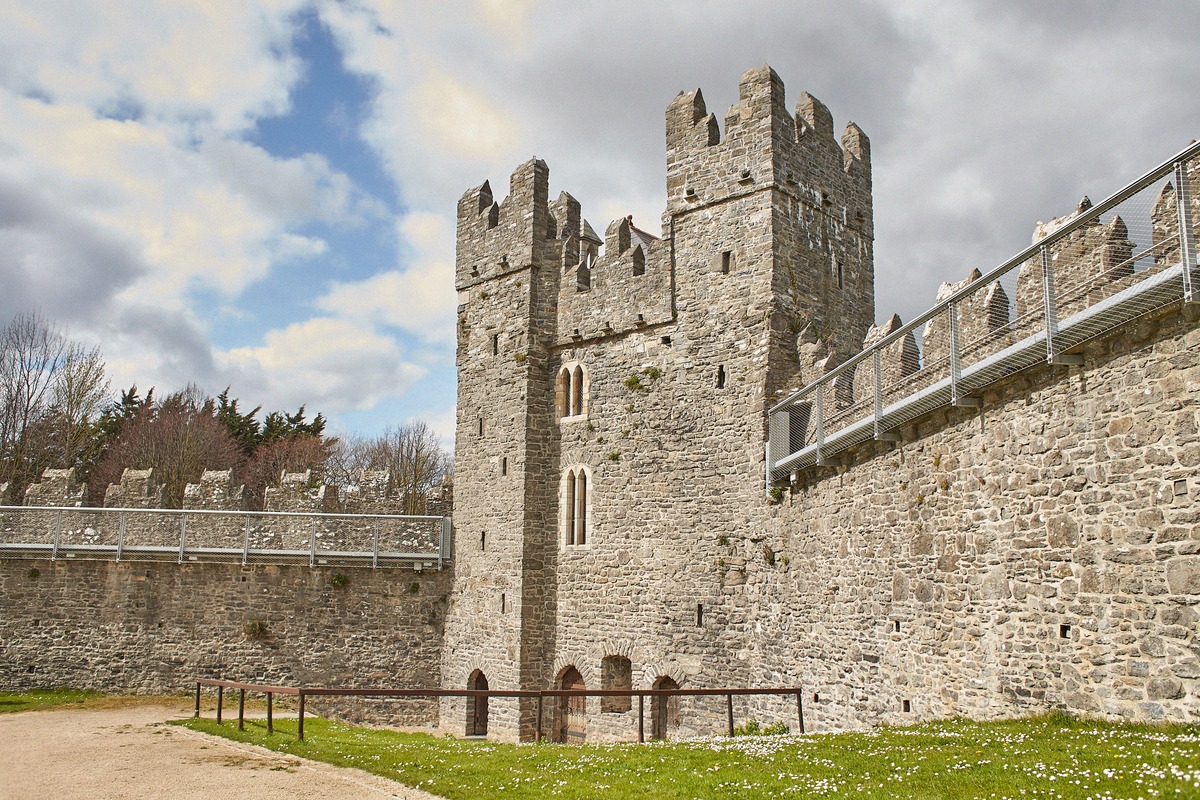
The site forms an irregular pentagon covering roughly 0.5 hectares, enclosed by a curtain wall between 260 and 305 metres long. The buildings were constructed over several centuries and reflect different phases of use. The surviving structures include:
- Constable's Tower in the north, built after 1450 during a phase of fortification. It housed the constable's living quarters and contains a garderobe (medieval latrine).
- Gatehouse complex in the south, in its present form dating from the mid-15th century, though a gatehouse already stood on the site in the 12th century.
- Chapel from the 13th century, unusually large, built as the archbishop's private place of worship. Excavations in 1971 uncovered a silver coin of Philip IV of France (1285-1314) here.
- Chamber Block, originally with three residential storeys; below it lay a bakehouse, stable, dairy and carpenter's workshop.
Decline and rediscovery
The archbishops used Swords Castle until the early 14th century. In 1317, the site suffered serious damage during the Bruce campaign, when Scottish troops laid waste to the surrounding area right up to the gates of Dublin. Archbishop Alexander Bicknor had a new palace built at Tallaght in 1324 and abandoned Swords.
In 1583, Sir Henry Sidney, Lord Deputy of Ireland, assigned the decaying castle as accommodation to forty Protestant refugee families from the Netherlands. After the disestablishment of the Church of Ireland in 1870, the estate passed to the Cobbe family, who leased it to local merchant Robert Savage; he laid out an orchard on the castle grounds.
The Office of Public Works took over supervision in the 1930s. In 1985, Dublin County Council (now Fingal County Council) acquired the castle with a view to a full restoration. The Constable's Tower was restored between 1996 and 1998, and the chapel received a new roof, reconstructed brickwork and new windows from 1995 onwards. During stabilisation works on the gatehouse in 2014, archaeologists uncovered seventeen burials, including the unusual prone burial of a woman. The site has also been used as a filming location, including for the television series "The Tudors" and "Vikings".
What to expect
Swords Castle is not a polished, museum-style castle attraction but an honest ruin with restored key buildings. The courtyard and ground-floor areas are accessible; towers and upper floors can only be reached via stairs. Allow a realistic 30 to 60 minutes, that's plenty of time for a walk around the courtyard, gatehouse, chapel and Constable's Tower.
The appeal lies in the quiet: Swords is considered a hidden gem and is usually far less busy than the region's larger castles. It's quietest early in the morning from opening time and on weekdays. On event days, such as "Concerts in the Castle" or the Fingal Food Market, it gets busier. Fingal County Council is currently developing the castle into a cultural hub for the town as part of the EU-co-funded "Swords Cultural Quarter" project; planned building works may limit access and facilities in 2026, so it's worth checking the current status before your visit.
Visiting: the practical details
Admission is free. The castle is open Tuesday to Sunday; it is closed on Mondays and bank holidays. Opening hours vary by season: 09:30 to 16:00 (last admission 15:30) from October to March, and 09:30 to 17:00 from March to October.
- Address: Bridge Street, Townparks, Swords, Co. Dublin, K67 X439, about 10 km north of Dublin city centre, and around 3 km from Dublin Airport.
- Guided tours: available on request through Fingal Tourism, subject to demand. Enquire by phone on +353 1 840 0891 or by email at [email protected]. There is no separate contact address for the castle itself.
- Parking: not available on the castle grounds; on-street parking can be found nearby, for example on Main Street or at the Castle Shopping Centre.
- Accessibility: the courtyard and ground-floor areas are accessible; towers and upper floors can only be reached via stairs.
- On site: don't expect catering or toilet facilities; dogs on leads are permitted.
Getting there
From the city centre, you can reach Swords by Dublin Bus or the Swords Express. There's no direct DART connection to Swords; if you're travelling by DART, it's worth combining the castle with a visit to Malahide instead. For tips on routes and fares, see the guide Public transport.
Combine your visit with
Swords lies in the Fingal area north of Dublin and combines well with other destinations nearby. Close by is the larger Malahide Castle, with a guided tour, gardens and a butterfly house, and further along the coast is Howth Castle. In the city centre, Dublin Castle rounds out the picture of Irish castle history. For more historic buildings, see the overview Castles and Fortresses, and for the wider context, the guide Dublin History.