
History & Landmarks in Dublin
From the Viking founding in 841 through Georgian Dublin to the 1916 Easter Rising - Dublin's historic landmarks and how to visit them.
Contents
Dublin's history isn't confined to museums, it's out on the street, in the city's own name, in the bullet holes scarring a post office façade, and in the wide Georgian squares. Once you know the key eras, the streetscape all but explains itself as you wander. This overview runs from the Vikings to independence, and tells you at each landmark what you can actually see, what it costs, and where you need to book ahead.
From "Dubh Linn" to the Anglo-Normans
Dublin owes its name to a pool of water. In 841, Vikings founded a fortified settlement at Dubh Linn, a dark tidal pool where the small River Poddle met the Liffey, today the area around Dublin Castle. "Dubh" means black or dark, "linn" means pool, so together "black pool". That date, 841, is taken as the city's founding.
The next defining era arrived from England. In 1169/1170, Anglo-Norman forces under Richard de Clare, known as Strongbow, conquered Dublin; in 1171, King Henry II of England personally confirmed his overlordship. This began nearly 750 years in which Dublin remained the centre of English rule in Ireland. The city's oldest surviving buildings date from this medieval layer, the Viking and medieval story is told vividly at the Dublinia experience museum right beside Christ Church Cathedral.
Georgian Dublin
Dublin's most architecturally splendid phase came in the 18th century. As the second-largest city in the British Empire, Georgian Dublin took shape with its rows of red-brick terraces, fanlights and colourful doors. The purpose-built Wide Streets Commission laid out broad thoroughfares and grand squares, including today's O'Connell Street (then Sackville Street) and the Georgian squares Merrion Square, Fitzwilliam Square, Mountjoy Square and Parnell Square.
That golden era ended abruptly with the Act of Union of 1800, which dissolved the Irish parliament and shifted governing power to Westminster. Dublin lost its political role, many aristocratic families left, and a long decline set in. To feel the Georgian scale today, walk across O'Connell Bridge: the bridge is wider than it is long, about 45 metres long but roughly as wide, because the old Carlisle Bridge was widened between 1877 and 1882 to match the full width of Sackville Street.
Sites of the 1916 Easter Rising
The turning point toward independence played out at a handful of sites that are easy to visit today. During the 1916 Easter Rising, rebels seized several strategic buildings. Their headquarters was the General Post Office (GPO) on O'Connell Street, where the Irish Republic was proclaimed. Other occupied positions included the Four Courts, Jacob's Biscuit Factory on Bishop Street, the South Dublin Union, Boland's Mill, and St Stephen's Green with the College of Surgeons.
Today the Rising can be experienced at two poles. The GPO façade on O'Connell Street still bears bullet scars, free to view from the street at any time. Inside, the GPO Witness History Museum tells the story interactively; it's a paid attraction, open Wednesday to Saturday from 10:00 to 17:00 according to current sources (last admission 16:00). Opening days and prices can change, so it's worth checking the official website before you go.
Kilmainham Gaol, book early
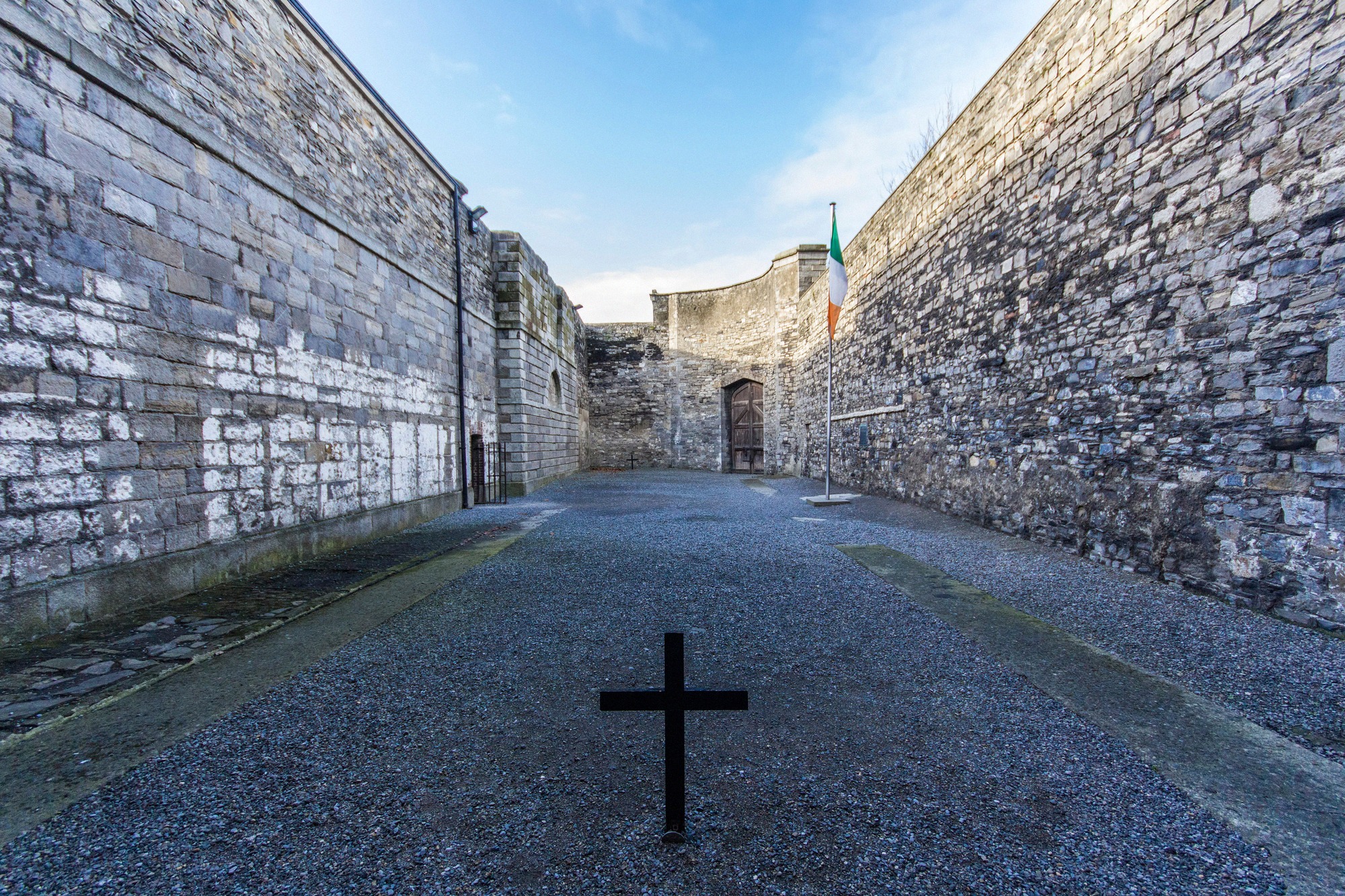
The counterpart to the GPO is the prison where the story of the Rising came to its end. At Kilmainham Gaol, the condemned leaders of 1916 were executed; the site is regarded as one of the most powerful memorials to the Irish independence struggle. Visits are guided-tour only, and tickets are in high demand.
Book ahead and only through official channels - Heritage Ireland or the museum's own website; tickets from third-party sellers are invalid. A batch of tickets is released 28 days in advance from midnight Irish time, so an early booking attempt significantly improves your odds. On the practicalities:
- Prices: adults €8, seniors 60+ €6, students and young people aged 12-17 €4, family ticket €20. Children under 12 go free but still need a ticket.
- Duration: allow around 90 minutes, the guided tour itself takes about an hour, plus time in the museum.
- On arrival: turn up around 15 minutes before your tour's start time.
Grand government buildings on the Liffey
Between the great historic events, the ceremonial buildings along the river tell their own story of civic ambition. The finest is the Custom House, the old customs building with its 14 river-god keystones by Edward Smyth. Since November 2021 there's been a Custom House Visitor Centre: you can go inside to see an exhibition on its construction, fire and restoration, plus its marble staircases; tickets are available through Heritage Ireland online or on site, and it's worth allowing an hour to ninety minutes. More details at Custom House.
Access to the other buildings varies:
- City Hall: the building and its permanent exhibition "The Story of the Capital" are free, Monday to Saturday from 10:00 to 17:15 (closed Sundays). See City Hall.
- Four Courts: the working courthouse can be admired from outside at any time; you may enter free of charge as a courtroom visitor and follow public hearings. A self-guided booklet is available at the Information Desk in the Round Hall, and there's a security check at the Inns Quay entrance. There is no regular commercial tour with a set price.
- Leinster House: home to the Irish parliament (the Houses of the Oireachtas). Open or walk-in tours aren't currently available; visits are limited to tours sponsored by a TD (member of parliament) or senator, free, but by prior arrangement only. A virtual tour is available online as an alternative. More at Leinster House.
Literary heritage with a view
Dublin's history is also one of words, and there's a special place for that far out along the bay. The James Joyce Tower & Museum in Sandycove is a Martello tower and also the setting of the opening scene of James Joyce's "Ulysses". Inside are Joyce mementos such as his walking stick, first editions and personal items; the old gun platform on the roof opens up a view across Dublin Bay.
Best of all, admission is free, the tower is run by volunteers and open Tuesday to Sunday from 10:00 to 16:00 (closed Mondays). Because of the narrow spiral staircase, though, it isn't wheelchair accessible.
Planning your history tour
Fitting every site into a single day is ambitious but doable, provided you lock in the fixed appointments first. Book Kilmainham Gaol first, since your tour time will anchor the rest of your day. Allow around 90 minutes for Kilmainham and an hour to ninety minutes for the Custom House Visitor Centre; the free outdoor sights, the GPO and the Liffey bridges, cost you nothing but the walk between them.
If you want to keep admission costs down, combine the free-to-visit sites: the GPO façade on O'Connell Street, O'Connell Bridge and the nearby Ha'penny Bridge, City Hall with its exhibition, and the James Joyce Tower as a longer excursion. For a broader overview of the city's main buildings, see our list of attractions, and if you're planning to visit several paid sites in one day, check our Dublin Pass guide.