
Dublin Weather & Climate
Mild ocean climate in the driest part of Ireland, climate data from the 1991-2020 normal period, what to expect each season, and what to pack.
Contents
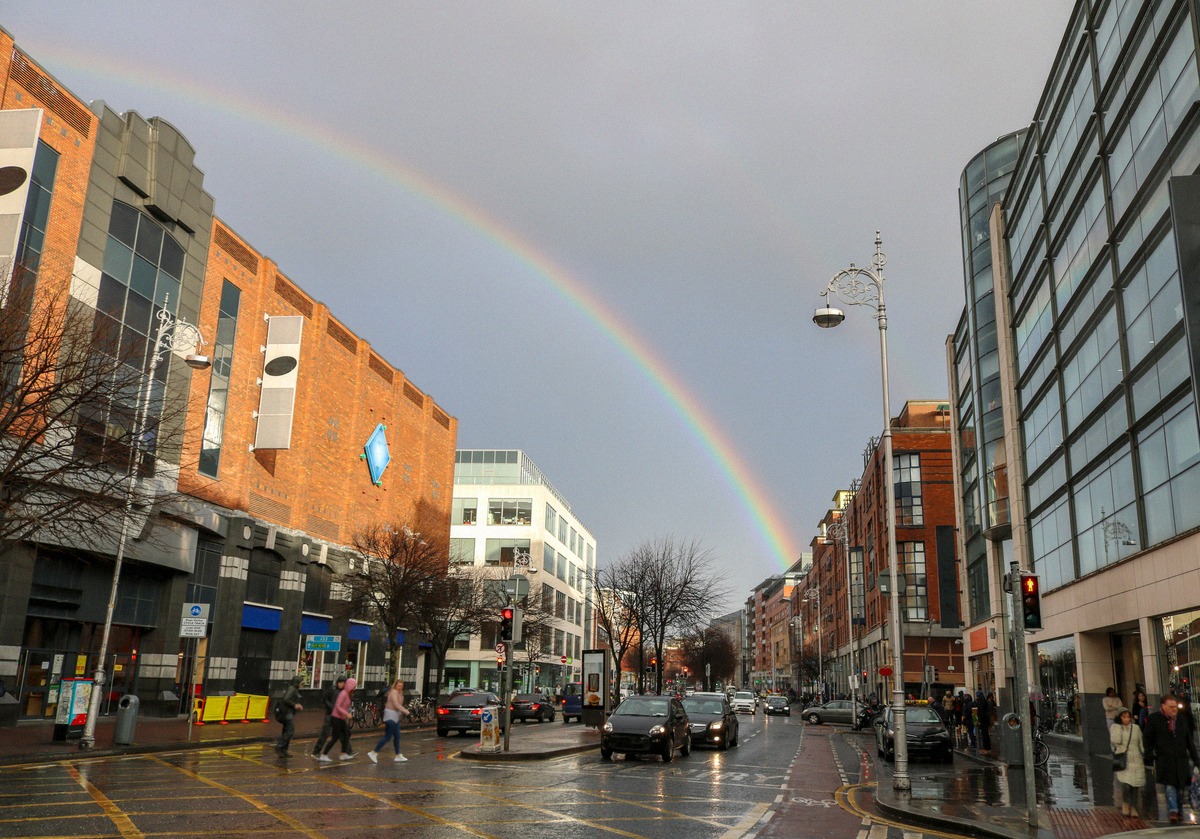
Dublin has a worse weather reputation than it deserves: the city sits in the driest part of Ireland, summers are mild, and evenings in June and July are long. What is true is the changeability, sun, cloud and a brief shower often alternate several times a day; genuine heatwaves and hard frosts don't happen here. All figures come from the Dublin Airport weather station and refer to the 1991-2020 climate normal period from Met Éireann, the Irish meteorological service, older figures in guidebooks tend to run a little low.
Temperatures, mild from January to December
The annual mean is 9.7 degrees, and the seasonal range is small: January averages between 2.3 and 8.0 degrees, July between 11.3 and 19.5 degrees. Average daily highs across the year:
- Winter - January 8.0 degrees, February 8.5 degrees, December 8.3 degrees
- Spring - March 10.1 degrees, April 12.3 degrees, May 14.8 degrees
- Summer - June 17.7 degrees, July 19.5 degrees, August 19.1 degrees
- Autumn - September 16.9 degrees, October 13.6 degrees, November 10.3 degrees
Real frost occurs on only around 35 days a year (almost entirely between November and March), and snow on around 12.5 days, it rarely settles in the mild city air. The same holds at the other end of the scale: readings above 25 degrees are the exception, and the all-time record was set on 18 July 2022 with 33 degrees in Phoenix Park.
Rain, often, but rarely heavy
Only 772.5 mm of rain falls at the airport each year, what matters is not the amount but the frequency. Met Éireann counts around 200 rain days (from 0.2 mm), of which about 137 are wet days (from 1.0 mm): it rains often, but usually briefly and lightly. Late autumn is the wettest stretch (November 82.7 mm), while spring from March to May is the driest (51 to 57 mm), yet even the driest month has more than 15 rain days. A few showers are pretty much a given.
Compared with the rest of Ireland, Dublin sits on the favourable side: the city lies on the east coast in the rain shadow of the western mountain ranges, where the Atlantic weather fronts drop most of their rain first. The west coast gets roughly double - Valentia Island around 1,400 mm, Galway 1,158 mm, and with around 1,450 hours of sunshine a year, Dublin is one of the sunnier spots in the country.
Daylight, an extreme swing
Dublin sits far to the north: around the summer solstice there are more than 17 hours of daylight, and even at the end of July the sun doesn't set until around 21:25, with true darkness only around 22:00, the often-quoted 23:00 isn't accurate. In December, by contrast, only around 7.5 hours of daylight remain. Average sunshine is around four hours a day across the year; May and June are the sunniest with around six hours, and December the greyest with around one and a half.
The seasons in practice
- Spring, the driest stretch of the year, with days lengthening quickly. If you want dry weather and long days without peak-season crowds, aim for late spring.
- Summer, the best time to visit, but a mild summer around 19 to 20 degrees, not a hot one. For the cool, long evenings, pack something warmer.
- Autumn - September is often underrated: still mild, less crowded. From October it tips noticeably towards wet, and the wind picks up.
- Winter, mild, but grey and dark early. The real factor here isn't the cold but wind and damp, easily managed with pubs and museums to duck into.
What often makes Dublin feel cooler than the thermometer suggests is that same wind (annual average around 19 km/h, 21 to 23 km/h in winter) and high humidity of 88 to 89 percent on winter mornings. In the dense city centre it also tends to run a touch milder than the airport weather station on the open outskirts, at night the difference to green spaces such as Phoenix Park can be several degrees.
Over the long term, Ireland is measurably getting warmer and wetter: up 0.7 degrees and around 7 percent more rainfall compared with 1961-1990, and summer 2025 was the warmest on record. What's increasing above all is mild nights and warm outlier years - 30-degree days remain rare in Dublin.
Best time to visit, month by month
For anything outdoors, May to September is the top choice, with May and June the driest and sunniest combination. Pure sightseeing works year-round, even winter stays mild enough, with a January average around 5 degrees, for museums, pubs and walks.
The months at a glance. The temperature is the average daily high per Met Éireann (1991-2020 normal period, Dublin Airport station); daylight and crowd levels are experience-based:
| Month | Avg high | Daylight | Crowds | What the month is good for |
|---|---|---|---|---|
| January | 8.0 °C | around 8 hrs | very low | museums, pubs, cheapest hotel rates |
| February | 8.5 °C | around 10 hrs | low | same as January, plus Six Nations rugby |
| March | 10.1 °C | around 12 hrs | high around the 17th | St Patrick's Festival, driest month on average |
| April | 12.3 °C | around 14 hrs | moderate | shoulder season, long bright afternoons |
| May | 14.8 °C | around 16 hrs | moderate | sunniest month, great for the Cliff Walk and parks |
| June | 17.7 °C | over 17 hrs | high | longest days, Bloomsday on 16 June |
| July | 19.5 °C | around 17 hrs | very high | warmest month, peak season with peak prices |
| August | 19.1 °C | around 15 hrs | very high | same as July, festival season |
| September | 16.9 °C | around 13 hrs | high | mild weather with shorter queues |
| October | 13.6 °C | around 11 hrs | moderate | shoulder season until mid-month, Open House Dublin |
| November | 10.3 °C | around 9 hrs | low | wettest month, but good value |
| December | 8.3 °C | around 7.5 hrs | busy on specific dates | Christmas markets and holidays, otherwise quiet |
In short: May, June and September offer the best balance of weather, daylight and crowds. July and August are the warmest, but also the busiest and priciest. January, February and November are the cheapest months, at the cost of daylight. For how this plays out in hotel prices, see the where to stay in Dublin guide; dates for the major festivals are on the events page.
What to pack
Because sun and showers often swap places several times a day, layering wins out:
- A waterproof, windproof jacket, the single most useful item, year-round
- Several thin layers rather than one thick item
- Sturdy, water-resistant footwear for pavements, parks and brief showers
- In summer a warmer layer for the evenings, in winter a scarf and hat against the damp wind
An umbrella is deliberately left off the list, in the gusty Atlantic winds it turns inside out fast. More on route planning is in the trip planning guide; why Dublin's climate is so mild is explained in the piece on Dublin's geography.