
Shopping in Dublin - Streets, Centres & Souvenirs
Where to shop in Dublin - Grafton Street, Henry Street and Clerys Quarter, Irish souvenirs, tax-free shopping for non-EU visitors, and opening hours.
Contents
The two shopping worlds either side of the Liffey
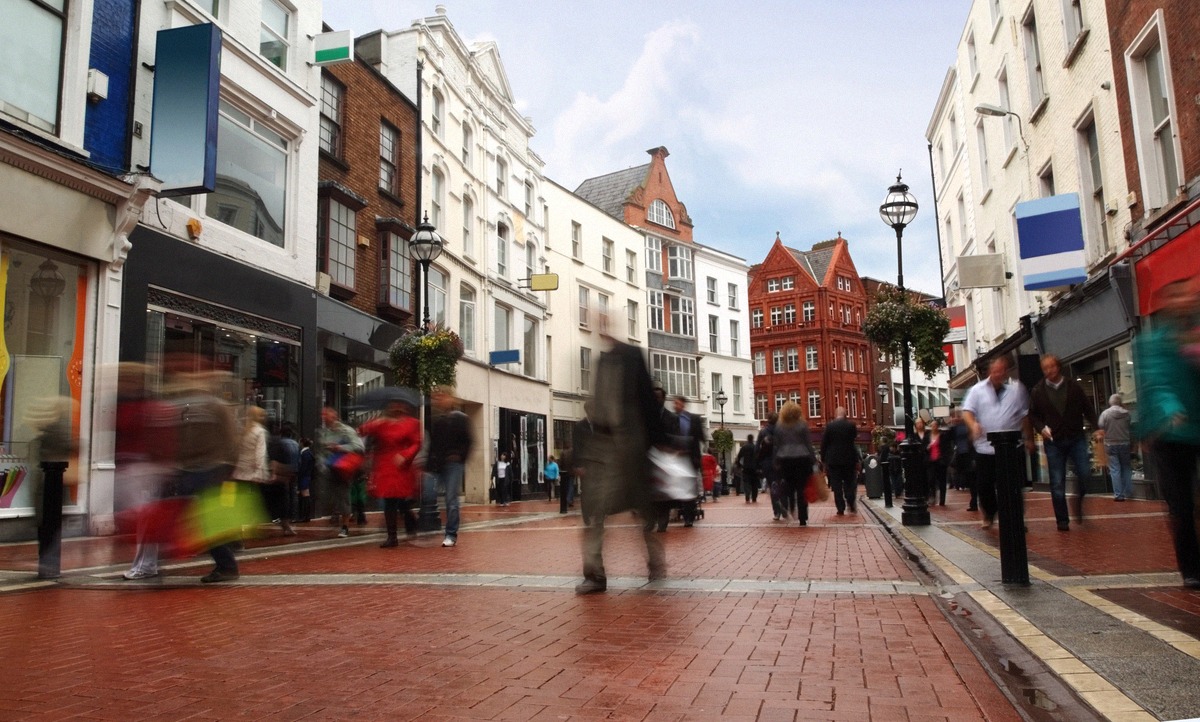
Dublin's shopping splits along the river. South of the Liffey, Grafton Street is the smarter, more polished strip, running between Trinity College and St Stephen's Green. This is where the upmarket department store Brown Thomas sits, buskers play outside the shop windows, and the side streets around Drury Street, Wicklow Street and Castle Market make up the so-called Creative Quarter, packed with independent boutiques and design shops. Worth seeing there are the Powerscourt Townhouse Centre, a Georgian townhouse converted into a shopping arcade, and the George's Street Arcade, a red-brick Victorian market hall.
North of the Liffey, things feel more down-to-earth and move at a faster pace. Henry Street and its continuation, Mary Street, form the busiest pedestrianised shopping strip in the city, loud, crowded, and dominated by high-street chains. Arnotts, Ireland's oldest department store, stands here alongside Zara, River Island and Penneys. One useful note for visitors from abroad: the chain known internationally as Primark trades under the name Penneys in its home country, Ireland. Its stores here are local institutions and are almost always busy.
Grafton Street, Dawson Street & the Creative Quarter
Running parallel to Grafton Street, Dawson Street is home to an address that will interest any book lover: Hodges Figgis, founded in 1768, name-checked in James Joyce's Ulysses, and today Waterstones' flagship store in Ireland. The shop underwent a major refit in 2024, carried out over five months while staying open, reopened on 24 September 2024, and increased its book stock by around 20 percent in the process. It now has reorganised customer areas and dedicated sections for rare books, remainder titles and non-book stock. The address is 56-58 Dawson Street. Opening hours are Monday to Wednesday 09:00-19:00, Thursday until 20:00 (late night), Friday 09:00-19:00, Saturday 09:00-18:00 and Sunday 12:00-18:00.
If you're after something away from the big chains, take a walk through the Creative Quarter. The independent shops around Drury Street stock Irish design, ceramics, jewellery and vintage pieces. Opening hours vary a lot from shop to shop; as a rule of thumb they open later than the department stores, usually around 10:00 or 11:00.
Henry Street, Clerys Quarter & the north side
The north side has made noticeable progress in recent years. The once-legendary Clery's department store on O'Connell Street is back as Clerys Quarter, a redeveloped complex that is far more than just retail. Alongside the shops it includes around 90,000 square feet of office space, a four-star hotel with 213 rooms, and dining options including a rooftop restaurant with panoramic views and the restored Clerys Tea Rooms. Two big names moved in as anchor tenants: H&M opened on 15 March 2024 across more than 30,000 square feet (around 2,800 square metres), and Decathlon followed in July 2024 with its city-centre flagship on a similar footprint and a 30-year lease, only its third Irish location.
Music fans should head for Henry Street, where HMV reopened in 2023. The store spans almost 560 square metres over three floors and stocks more than 15,000 products, including over 5,000 vinyl albums and 5,500 CDs, plus plenty of pop-culture merchandise. Follow Henry Street to its end and you reach Moore Street, with its historic street market, which has been given fresh life over the years by Afro-Caribbean and Asian traders.
Irish souvenirs, and what they cost
Beyond shamrock fridge magnets, it's worth seeking out genuine Irish craft products. The following addresses are all within walking distance of the city centre:
- Irish knitwear (Avoca, Suffolk Street): Aran Merino jumpers from Aran Woollen Mills start at around 139.95 euros here. Avoca sits at the pricier end but is known for blankets and scarves in contemporary colours.
- Donegal tweed (Kevin & Howlin, Nassau Street): The specialist for handwoven tweed. A crushable tweed cap costs around 46 euros, alongside waistcoats, jackets and hats.
- Chocolate & whiskey: Butlers Chocolates is Ireland's best-known chocolate brand, with smaller boxes of pralines available for just a few euros. For whiskey, the Celtic Whiskey Shop on Dawson Street offers a large selection, knowledgeable staff and miniatures that are easy to pack in a suitcase.
- Literary souvenir (Sweny's, Lincoln Place): The former pharmacy, now a Joycean cultural centre, sells the lemon soap immortalised in Ulysses, handmade in Wexford, for 5 euros. For more on the city's literary side, see our guide to literary Dublin.
For Irish design without the souvenir-shop kitsch, the Irish Design Shop on Drury Street and Jam Art Factory, with its modern landmark prints, are also worth a look.
Tax-free shopping for visitors from outside the EU
If you're resident outside the EU, you can claim back Irish VAT on goods you buy here - EU residents cannot. Here's what applies:
- Minimum spend: 75 euros in a single shop on the same day.
- Residency: you must live outside the EU for at least six months of the year.
- Export deadline: goods must be exported from the EU within three months of the end of the month of purchase.
The process is handled by providers such as Global Blue or Planet, who issue the paperwork in-store when you buy. Dublin Airport has a customs stamp desk in the departures hall for this, plus a Global Blue kiosk airside, beyond security. Allow around 30 minutes before check-in so there's time for stamping and processing the refund. For practical tips on the terminal process, see our guide to Dublin Airport.
Shopping centres & big malls
In typically wet Irish weather, the shopping centres make a welcome refuge. In the city centre, the Stephen's Green Shopping Centre stands out for its Victorian glass architecture; it's open Monday to Wednesday 08:30-19:00, Thursday until 20:00 (late night), Friday and Saturday 08:30-19:00, and Sunday 11:00-18:00. The Jervis Shopping Centre sits right next to a Luas stop and is a good option for high-street chains under one roof.
For a dedicated shopping trip, head out to the edge of the city:
- Blanchardstown Centre: Ireland's largest destination shopping centre, north-west of the city, with over 180 shops, three retail parks, around 25 restaurants and roughly 7,000 free parking spaces, a day out in its own right.
- Liffey Valley Shopping Centre: West of the city on the N4, with over 80 shops, around 20 restaurants and a 14-screen cinema. Noticeably more compact than Blanchardstown, but good for an afternoon of fashion shopping and a film.
Opening hours, getting there & staying safe
Most shops in the city centre open between 09:00 and 10:00 and close around 18:00 or 19:00 on weekdays. Thursday is the classic late-night shopping day, when many stores stay open until 20:00, including Hodges Figgis, Arnotts and the Stephen's Green Shopping Centre. Almost everything is open on Sundays, though with shorter hours, often not starting until 11:00 or 12:00; Arnotts, for example, opens 11:00-19:00 on Sundays. There's no single, standard late-night policy across all the flagship stores, so it's worth checking a shop's own website if you're not sure.
The Luas tram is the easiest way to get around for shopping: the Red Line takes you towards Henry Street, the Green Line towards Grafton Street. At peak times the Red Line runs roughly every 3 to 10 minutes, the Green Line every 5 to 10 minutes. A single fare with the Leap Card costs around €2.00 to €2.60 depending on zones, with cash fares priced higher. For how to get and top up a Leap Card, see our guide to the Leap Card, and for an overview of other connections, see public transport.
Dublin is generally safe, but keep an eye on your belongings in the busy shopping areas. In April 2025, An Garda Síochána stepped up visible patrols in the city centre, focused on O'Connell Street and Henry Street, targeting shoplifting and aggressive begging among other issues. Pickpocket warnings have also been issued around Grafton Street and other busy tourist areas, staying alert to your bag and wallet in crowds is generally enough. Read more in our guide to safety in Dublin.