
Dublin in Numbers
Population, area, location, currency, language and time zone - the essential facts about Dublin, concise and sourced.
Contents
This page collects the hard facts about Dublin: population figures from the census, area, location, currency, language, time zone and the city's place in the Irish economy. If you're planning a trip, the practical topics live in their own guides; here you'll find the numbers behind them.
Key facts at a glance
| Fact | Info |
|---|---|
| Population, city | 592,713 (Dublin City Council, 2022 census, CSO) |
| Population, county | 1,458,154 (County Dublin, 2022 census) |
| Area, city | around 117.8 km² (Dublin City Council) |
| Area, urban region | around 345 km² |
| Location | east coast of Ireland, around 53°N / 6°W, where the Liffey meets Dublin Bay |
| Country | Republic of Ireland (EU member, not in the Schengen Area) |
| Currency | Euro (€) - Northern Ireland uses pounds sterling |
| Languages | Irish (Gaelic) and English, both official |
| Time zone | GMT, IST in summer |
| Phone code | +353, Dublin area code 01 |
| Power sockets | Type G, three-pin, adapter needed |
| Emergency number | 112 or 999 |
| Airport code | DUB |
Population
The population figures come from the Central Statistics Office's (CSO) 2022 census: just under 600,000 in the Dublin City Council area, around 1.45 million across County Dublin, up 8 per cent on 2016. When people say "Dublin", they may mean either figure depending on context - the difference is around 865,000 people.
Dublin is Ireland's most international city: around one in six people in the county holds no Irish citizenship, with the largest groups coming from Poland, India, Brazil and Great Britain. The most diverse patch is Parnell Street East, with supermarkets and restaurants from all over the world.
The religious landscape is also shifting fast: the share of Catholics nationwide fell from 79 per cent (2016) to 69 per cent (2022), while Muslim, Orthodox and Hindu communities are growing. The Catholic roots feature in the Dublin churches guide, and the wider cultural heritage in our piece on Irish traditions and customs.
Location, area and cityscape
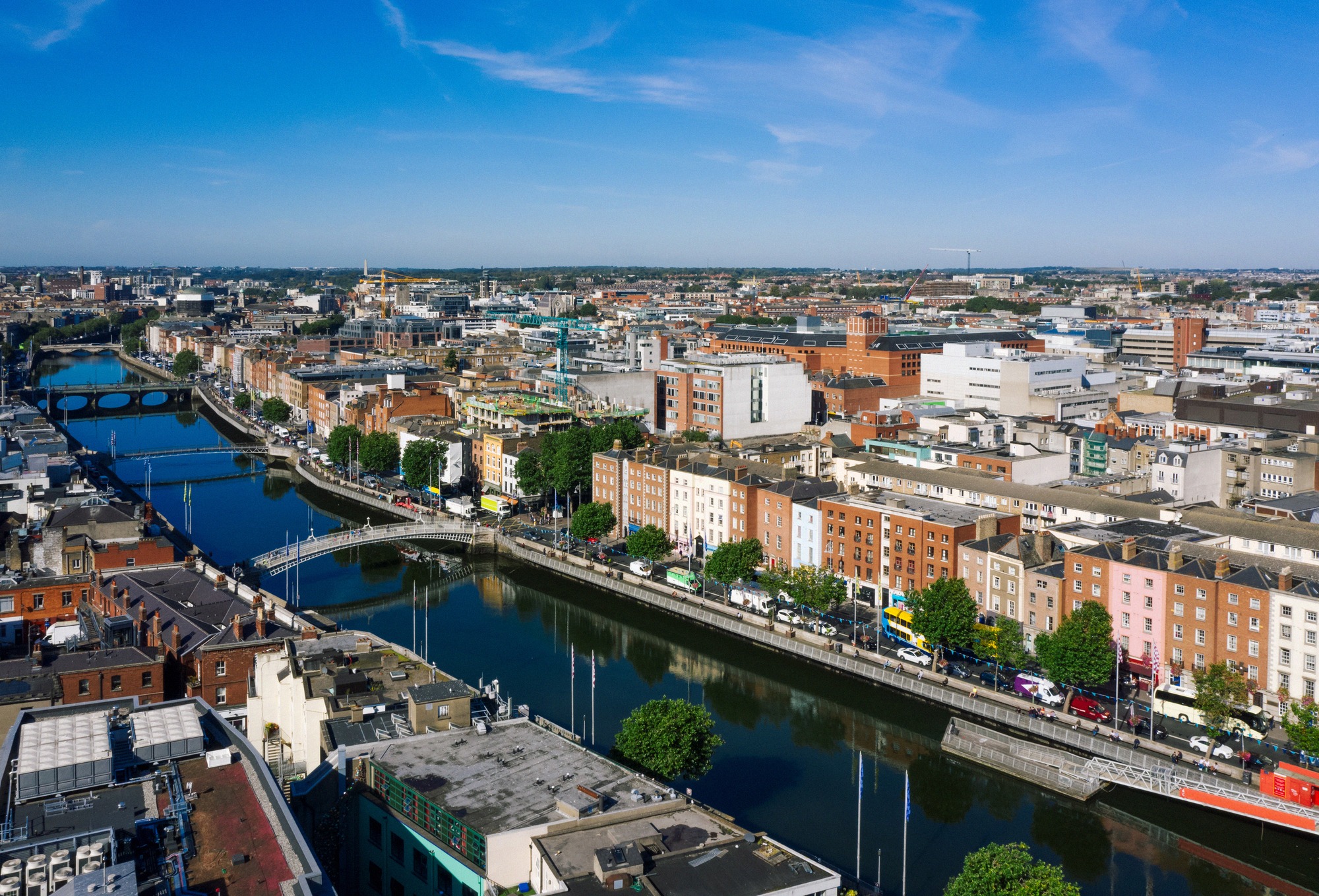
Dublin sits on Ireland's east coast, where the River Liffey flows into Dublin Bay and on into the Irish Sea. The city area is flat and only a few metres above sea level; to the south the Dublin Mountains rise as an outlier of the Wicklow Mountains, while to the north the Howth peninsula closes off the bay.
The Liffey splits the city into a north and south side, and the postal districts follow that logic: odd numbers (Dublin 1, 3, 5...) lie north of the river, even numbers (Dublin 2, 4, 6...) lie south of it. For visitors, that's the quickest way to get your bearings. How the bay, hills and surrounding area fit together is covered in our Where is Dublin guide; the neighbourhoods themselves are profiled in the Neighbourhoods hub.
Language, currency and time zone
Language: Ireland has two official languages, Irish (Gaeilge) and English. Day to day in Dublin, English is what you'll hear; Irish shows up on bilingual street and station signs and in transport announcements. For more on the Dublin accent and useful phrases, see our Language in Dublin guide.
Currency: the euro. Ireland is part of the Eurozone, so there's no need to change money. Card payment works almost everywhere; the exception is the city bus, which takes neither notes nor gives change. Planning a day trip across the border to Northern Ireland? You'll need pounds sterling there.
Time: Ireland is in the GMT time zone, IST in summer. Clocks change on the same dates as across the rest of Europe.
Power and connectivity: sockets are the UK-style Type G, three flat pins, so an adapter is essential. The 230-volt supply matches most of Europe, so a voltage converter isn't needed.
Economy - Silicon Docks, pharma, Guinness and tourism
Dublin is one of Europe's wealthiest economic regions; the area generates over 40 per cent of Ireland's GDP. Four pillars stand out:
- Tech: 16 of the world's 20 biggest tech companies have a presence in Ireland. Around Grand Canal Dock, the "Silicon Docks", sit the European headquarters of Google, Meta, Amazon, LinkedIn and Stripe; Google alone employs around 8,000 people in Dublin.
- Pharma: the export engine - medical and pharmaceutical products made up over half of Ireland's goods exports in 2025.
- Brewing: dating back to Arthur Guinness's 9,000-year lease of 1759 at St. James's Gate. The Guinness Storehouse there has been Ireland's most-visited paid attraction for 15 years running (around 1.65 million visitors in 2024).
- Tourism and transport: Ireland recorded around 6.16 million overseas visitors in 2025, with Dublin as the main gateway, and home to Ryanair, Europe's biggest airline (headquartered in Swords).
You can see this economic shift for yourself in the Docklands: Grand Canal Square is home to Daniel Libeskind's Bord Gáis Energy Theatre and the award-winning EPIC The Irish Emigration Museum; down by the water, the Famine Memorial and the tall ship Jeanie Johnston recall the story of emigration.
One figure that hits visitors directly: housing is expensive. The average rent for a two-bedroom flat stood at around €2,600 in early 2026, with less than one per cent of rental homes available. That feeds through into hotel and restaurant prices too.
Where to read more
This page deliberately sticks to the numbers. For the trip itself, other pages take it from here:
- Getting there, costs, paying, adapters and mobile data: Trip planning
- Temperatures, rainfall and the best time to visit: Weather and climate
- Bus, Luas, DART and the Leap Card: Public transport and the Leap Card
- From the airport into the centre: Dublin Airport
- What to see: Attractions and Museums
- History from the Vikings to independence: History of Dublin